
Conventional financing
Senior acquisition financing through banks and other conventional lenders for established businesses and qualified buyers.
How we approach it: Conventional financingCapital advisory for business acquisitions
We help buyers, operators, investors and M&A advisors figure out what a business can actually support, build the financing structure and take the deal to lenders and capital providers that fit.
From the initial review through closing, we stay actively involved as the deal moves through underwriting, diligence and funding.
Illustrative example only. Actual leverage, rates, equity requirements and seller-note treatment vary by buyer, lender and transaction.
In 0:55
Every acquisition comes down to one question. What can this transaction actually support? We start with the business: the debt its cash flow can carry, the equity it needs, and the structure that fits. Sometimes one lender is enough. Often, the right answer is a structure. Senior debt, subordinated debt, seller financing and equity, each sized to what the business can service. Then we take the transaction to the capital providers whose mandate fits it. And we manage it through underwriting, diligence and documentation, to funding. For buyers, operators and investors, and for the advisors who represent the deal. Discuss your transaction with Duneland.
What we do
Financing an acquisition is more than finding a lender. The business has to support the debt, the buyer has to bring enough capital, the add-backs have to survive underwriting and the deal terms have to work. We work through those issues first, build the financing structure, take the opportunity to lenders that fit and stay involved through funding.
Senior acquisition financing through banks and other conventional lenders for established businesses and qualified buyers.
How we approach it: Conventional financingSBA-backed acquisition financing when the buyer, business and structure fit current program and lender requirements.
How we approach it: SBA financingFlexible financing for larger or more complex acquisitions that do not fit traditional bank underwriting.
How we approach it: Private creditSenior debt, seller financing, subordinated debt and/or outside equity combined when one source is not enough to finance the deal.
How we approach it: Structured capitalHow we are different
“Who will lend on this deal?”
“What can this deal actually support, and how should it be financed?”
Finding a lender is only part of the job. We first look at the business, buyer, purchase price, cash flow, add-backs, available equity and deal terms to determine what the acquisition can realistically support. Then we build the structure and take it to lenders that fit. Doing that work early helps uncover financing problems before they become closing problems.
Before we approach lenders
Most acquisition-financing decisions come back to six questions. Here is how they play out on the illustrative $2,500,000 acquisition above. The figures are model inputs and outputs, not borrowing limits or approval results. Use the linked tools to explore the assumptions for your own deal.
How much debt is modeled here?
$2,000,000
$520,000 of cash flow against $324,018 of annual debt service
DSCR calculatorHow much buyer equity is assumed?
$500,000
20% of the purchase price, in this structure
Capital stack calculatorHow is the purchase price funded?
70 / 10 / 20
Senior debt, seller note and buyer equity, as shares of the price
Seller financing calculatorWhat is the modeled debt coverage?
1.60×
Modeled cash flow divided by annual debt service. Eligibility, valuation and lender adjustments remain separate tests.
Valuation and SDE calculatorWhich route does this illustration resemble?
Conventional financing
These shares illustrate a possible structure; they do not determine program eligibility or lender fit.
SBA eligibility calculatorWhat does the buyer need to demonstrate?
Earnings, equity, experience
Documented cash flow, a verified source of equity and relevant operating history
Acquisition loan calculatorThis example funds the purchase price only. Add transaction costs and incremental working capital to a complete project budget, and keep retained buyer liquidity separate. See what to bring to a preliminary financing review.
Who we work with
Individuals buying privately held businesses and existing owners pursuing add-on acquisitions.
Discuss an acquisitionExperienced buyers and sponsors seeking bank financing, private credit or a more structured solution.
Discuss a capital structureBrokers with a listing that needs a buyer, or a transaction that needs a financing and structure review. All buyer conversations go through Duneland.
See how we work with advisorsExperienced acquirers financing larger or more complex transactions.
Discuss a larger transactionHow we work
Review the business, buyer, purchase price, cash flow, add-backs, available equity and proposed terms.
Determine how much debt the business can support and how the rest of the purchase should be funded.
Take the deal to lenders and capital providers that fit the size, industry and structure.
Manage underwriting, diligence, lender questions, approvals, documentation and funding.
In a client’s words
Andrew describes his experience with Duneland during the acquisition LOI and financing process.
Client feedback shared by email
“Their workflow and document organization are clean and well structured, which makes it easy to track which items are still missing from sellers and which are fully accounted for.”
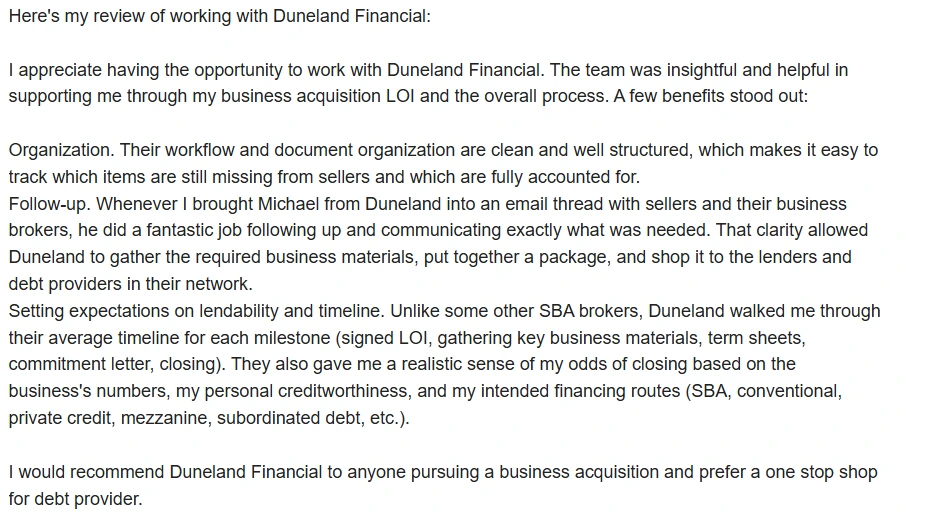
Here's my review of working with Duneland Financial:
I appreciate having the opportunity to work with Duneland Financial. The team was insightful and helpful in supporting me through my business acquisition LOI and the overall process. A few benefits stood out:
Organization. Their workflow and document organization are clean and well structured, which makes it easy to track which items are still missing from sellers and which are fully accounted for.
Follow-up. Whenever I brought Michael from Duneland into an email thread with sellers and their business brokers, he did a fantastic job following up and communicating exactly what was needed. That clarity allowed Duneland to gather the required business materials, put together a package, and shop it to the lenders and debt providers in their network.
Setting expectations on lendability and timeline. Unlike some other SBA brokers, Duneland walked me through their average timeline for each milestone (signed LOI, gathering key business materials, term sheets, commitment letter, closing). They also gave me a realistic sense of my odds of closing based on the business's numbers, my personal creditworthiness, and my intended financing routes (SBA, conventional, private credit, mezzanine, subordinated debt, etc.).
I would recommend Duneland Financial to anyone pursuing a business acquisition and prefer a one stop shop for debt provider.
Warmly,
Andrew
From the original email
Screenshot cropped to remove the email header and recipient details.
 Open screenshot at full size ↗
For M&A advisors and business brokers
We help M&A advisors and brokers pressure-test buyer capacity and deal structure earlier — before financing becomes the reason a transaction falls apart. That can mean identifying an unrealistic equity assumption, an add-back a lender will not accept, a seller note that needs to change or simply determining that a different financing route makes more sense.
Need a buyer for a listing? Explore active buyer mandates and submit the opportunity to Duneland. We assess the fit and coordinate any introduction.
Closed transactions
Landscaping and snow removal company
The buyer needed acquisition financing and additional working capital on a tight timeline.
What Duneland arranged: Landscaping and snow removal companyChildren's toy brand
Approval was not the only hurdle. The deal needed a bank willing to get comfortable with an asset-light eCommerce model and a non-traditional inventory structure.
What Duneland arranged: Children's toy brandPackaging company
Two green card holders had limited financing options and needed a structure that kept cash out of pocket to a minimum.
What Duneland arranged: Packaging companyCapabilities
We pressure-test the business, buyer and proposed structure before taking the deal to lenders.
Access across 1,500+ banks, SBA lenders, credit unions, private credit funds, family offices and institutional capital providers.
We stay involved from the initial financing review through underwriting, documentation and funding.
Network figures are supplied by Duneland and describe access, not lender approval or availability for every transaction. About Duneland Financial
Additional financing
Acquisition financing is our core focus, but the same relationships can support other business financing needs before, during or after a transaction.
Resources
Model valuation, seller financing, debt service, the capital stack and basic SBA eligibility using your own assumptions.
All tools, guides and researchHow the calculators fit togetherAll insights
We figure out how the deal should be financed and then help get it financed. We review the business, buyer and proposed terms, build the financing structure, approach lenders that fit and manage the process through funding.
A bank can only offer products under its own credit policy. We can evaluate multiple financing routes and determine which one fits the actual deal.
We work across acquisitions from roughly $500K through $25M+, with the financing approach depending on the size and complexity of the deal.
It depends on the business, buyer and financing route. Closing costs, working capital and post-close liquidity can matter just as much as the down payment.
SBA is only one financing route. Under current SBA rules, lawful permanent residents (green card holders) cannot own any portion of a business receiving SBA 7(a) financing, making non-SBA financing especially important for those buyers. Depending on the buyer and transaction, alternatives can include conventional bank debt, private credit, seller financing, outside equity or a combination of those sources.
Begin the financing review before signing an LOI. Assess the business’s repayment capacity, buyer cash and proposed terms early; a preliminary discussion is not a commitment. Formal underwriting and funding conditions still need to be completed.
Whether you have a signed LOI, are preparing an offer or are still evaluating the opportunity, send us the basic numbers and where you are in the process. We’ll look at the business, buyer and proposed structure and determine what the financing path may look like. No deal yet? Tell us what you are exploring, and we’ll show you the financing paths that may fit.