
What Does an SBA Business Acquisition Loan Cost?
On this page
Research date: September 17, 2026.
Policy scope: Written September 17, 2026. References to SOP 8.1 describe the incoming framework applicable under SBA’s October 1, 2026 transition notice; prior-version statements are identified separately.
Two financing proposals can quote the same interest rate and produce different monthly payments, upfront cash needs, and exit costs. Principal, amortization, fees, payment timing, and contractual restrictions all affect the borrowing decision.
An acquisition buyer therefore needs more than a rate comparison. The useful comparison is a complete schedule: how much is borrowed, how much is paid at closing, what payments are due over time, and what happens if rates change or the loan is repaid early.
TL;DR: SBA loan pricing combines a negotiated rate within applicable program limits, fees, and repayment terms. A maximum permitted rate is not your offered rate. Under incoming 8.1, acquisition amortization is limited to ten years apart from specified real-estate structuring. Compare dated term sheets using the same principal, uses, and assumptions, then test payment sensitivity. SBA lender guidance; SOP 8.1, Appendix 15
How are SBA loan rates determined?
SBA’s lender guidance says borrower and lender negotiate the rate subject to program maximums, with fixed and variable structures available. Its displayed variable-rate table sets different maximum spreads by loan size, including base plus 3.0% for loans above $350,000. Confirm the permitted base and applicable rule at the time of the actual quote. SBA lender resources, “Interest rates”
This article does not quote a current prime rate or promise a borrower’s spread. Rates change, and an illustrative calculation should not be mistaken for live pricing.
When comparing proposals, record the base rate, spread, reset frequency, floor if any, quoted date, and the period for which the terms remain available. Ask how a reset changes the payment schedule.
What does the rate do to monthly payments?
For a hypothetical $990,000 loan amortized monthly over ten years, the payment changes materially across assumed rates. The following values come from a standard fixed-rate amortization formula and exclude fees, irregular first periods, and floating-rate changes. Calculation methodology
| Assumed annual rate | Monthly payment | Annual payments |
|---|---|---|
| 8% | $12,011.43 | $144,137.18 |
| 10% | $13,082.92 | $156,995.08 |
| 12% | $14,203.62 | $170,443.49 |
The 10% and 12% cases differ by roughly $13,448 per year. A buyer should compare that change with the business’s accepted cash flow, not merely with the purchase price.
The DSCR guide applies the same payments to a coverage example. These assumptions are not current market offers.
Which fees should the buyer identify?
Separate the program’s upfront guarantee fee, permitted lender or agent charges, third-party expenses, and costs paid outside the loan. SBA’s guidance distinguishes an upfront fee that may be passed to the borrower from the lender’s annual service fee, which may not be charged to the borrower. Applicable fee amounts are published by fiscal year. SBA lender resources, “Fees”
Use the actual fee schedule and term sheet rather than a timeless percentage copied from an older article. The relevant date, loan structure, amount, and applicable exceptions can affect the calculation.
| Cost question | What to request |
|---|---|
| Is the amount a program fee? | Current official schedule and calculation |
| Is it a lender/agent fee? | Description, permitted basis, and disclosure |
| Is it a third-party expense? | Scope and provider estimate |
| Is it financed or paid separately? | Sources-and-uses treatment |
| Has it already been paid? | Credit or remaining-balance reconciliation |
The project-cost guide explains how to keep these items from being counted twice.
Is the loan term the same as amortization?
Loan maturity identifies when the obligation becomes due; amortization describes how principal is scheduled to be repaid. In a fully amortizing loan, scheduled payments reduce principal to zero at maturity. A balloon structure leaves a balance due at the end. Under 8.1, 7(a) loans facilitating a change of ownership must state amortization and maturity and may not have a balloon. SOP 8.1, Appendix 15, “Loan Maturities”
The acquisition component may not exceed ten years of amortization. Where qualifying real estate is included, the appendix permits separate financing or a weighted blended structure; only the real-estate portion receives the longer allowable term in that calculation. SOP 8.1
Do not apply a twenty-five-year real-estate term to every dollar in a combined acquisition merely because property is part of the purchase.
What should buyers check about prepayment?
SBA’s published guidance describes a subsidy-recoupment fee for qualifying voluntary prepayments on loans with maturities of fifteen years or longer during the first three years. The stated trigger and percentages are specific; it is inaccurate to assume every SBA acquisition loan has the same prepayment charge. SBA lender resources, “Prepayment penalties”
Review the actual note and all proposed financing documents. If a transaction also uses seller or non-bank debt, those instruments have their own repayment terms. A buyer considering a near-term refinance should model the entire capital stack, not only the senior rate.
How should two proposals be compared?
Normalize the comparison before ranking terms. Use the same project uses, buyer contribution, principal, and modeled holding period. Then show cash due, recurring payments, variable-rate sensitivity, covenants, collateral and guarantees, and any exit cost. This is a decision framework, not a claim that one financing route is always cheaper. OCC commercial lending guidance
A lower initial payment may reflect a different repayment profile rather than a lower total economic cost. Equally, a low headline rate may omit significant upfront cash requirements. Where necessary, ask the financing team to explain the cash flows in dollar terms.
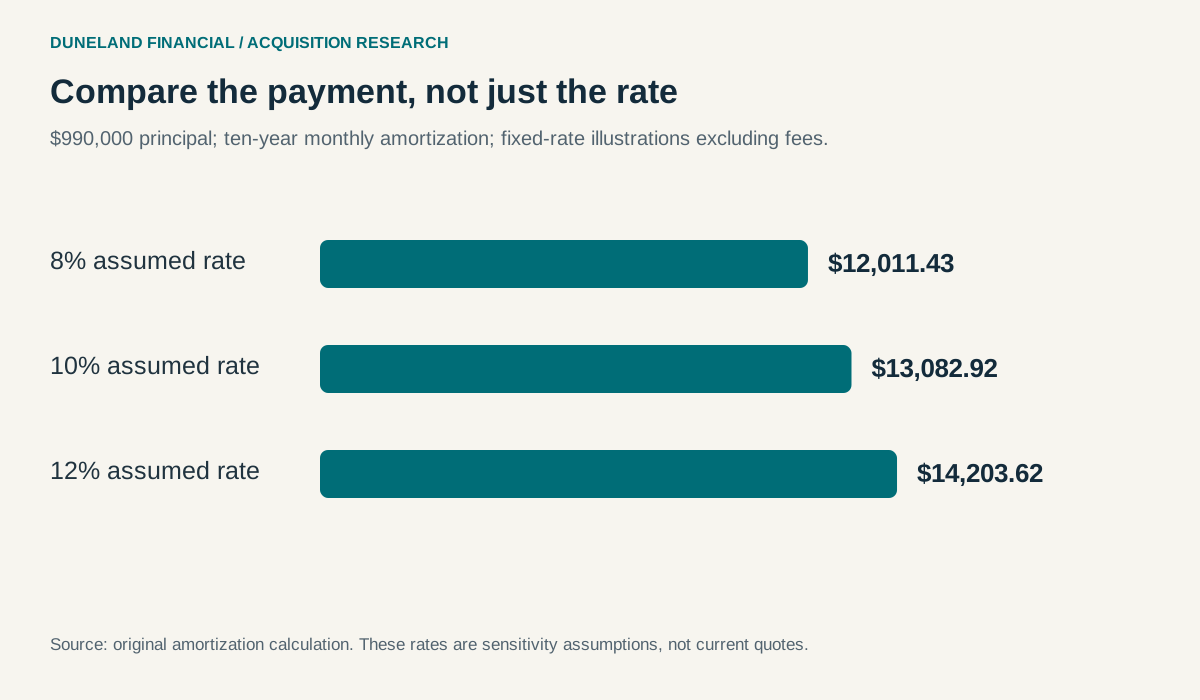
Fixed-rate arithmetic excluding fees; no current market quote is implied.
Frequently asked questions
Is the maximum SBA rate the rate I will pay?
No. A program ceiling limits the permissible rate; the lender’s actual offer is a separate negotiated term. SBA lender guidance
Are the example rates current quotes?
No. They are labeled calculation assumptions used to demonstrate sensitivity. Scenario methodology
Is the payment table an APR calculation?
No. It models principal and interest under specified assumptions. It does not incorporate fees into an annual percentage cost.
Compare the full borrowing schedule
The rate matters because it changes the cash the business must generate. It should be evaluated alongside fees, principal, amortization, and repayment restrictions. A complete comparison gives the buyer a clearer view of both closing affordability and operating pressure after the acquisition.
Collect dated terms, reconcile them with the sources-and-uses budget, and test plausible payment changes against accepted earnings. The strongest financing discussion then focuses on the structure’s actual demands rather than a single percentage in a proposal.
Review your acquisition financing options, or compare SBA and conventional financing.
Continue reading
- SBA Business Acquisition Financing: A Buyer’s Guide
- SBA Total Project Cost: Why Purchase Price Is Only the Starting Point
- DSCR for Acquisition Loans: How Much Debt Can the Business Support?
- SBA vs. Conventional Financing for Buying a Business
- Acquisition financing library