
SBA Total Project Cost: Why Purchase Price Is Only the Starting Point
On this page
Research date: September 17, 2026.
Policy scope: Written September 17, 2026. References to SOP 8.1 describe the incoming framework applicable under SBA’s October 1, 2026 transition notice; prior-version statements are identified separately.
A purchase agreement answers what changes hands between buyer and seller. A financing budget must also answer what money is needed, when it is needed, and who provides it.
Confusion begins when those two documents use the same headline number. A $1 million price can coexist with a larger financing project, additional expenses paid outside that project, and funds the buyer intends to retain. Combining those amounts carelessly can either understate the cash needed or count the same expense twice.
TL;DR: Build a sources-and-uses schedule before calculating the buyer contribution. Show purchase price, incremental working capital, eligible project costs, separate unfinanced expenses, and retained liquidity distinctly. Under the incoming SBA acquisition rules, the contribution calculation considers the defined project and additional loan uses, with category-specific provisions. Cost eligibility and timing need lender confirmation. SOP 8.1, Appendix 15
What is the difference between purchase price and project uses?
Purchase price is the negotiated consideration for what the seller transfers. Project uses identify the transaction’s financing requirements. The SBA 7(a) program permits several uses, including ownership changes, working capital, equipment, and qualifying real estate transactions; that does not make every item in an acquisition budget automatically eligible. SBA 7(a) program
Begin with the purchase agreement’s definitions. Does the price include inventory? What working capital must be delivered? Is real estate included? Is debt assumed, repaid, or excluded? The budget should reflect those answers before new amounts are added.
These questions are particularly important when a broker’s price summary differs from the draft legal documents. A clear schedule creates one consistent funding model for the buyer, lender, and transaction team.
What should a sources-and-uses schedule contain?
A useful schedule connects each use to an amount, evidence, payment timing, and funding source. Its total sources must equal total uses for the defined project. Separate non-project resource needs should remain visible without being inserted as if they were financed uses. Scenario methodology
| Use | Amount | Treatment in this illustration |
|---|---|---|
| Purchase price | $1,000,000 | Business consideration |
| Incremental working capital | $75,000 | Additional to purchase package |
| Project expenses | $25,000 | Assumed eligible |
| Total project uses | $1,100,000 | Must match project sources |
| Source | Amount |
|---|---|
| Senior debt | $990,000 |
| Buyer cash | $110,000 |
| Total project sources | $1,100,000 |
The example assumes a 10% contribution and no seller financing. It does not assess eligibility or valuation. The twenty-scenario study uses the same baseline so readers can trace changes consistently.
How should working capital be handled?
Identify what working capital is delivered within the purchase and what additional cash the company needs to operate after the acquisition. Working capital is an eligible 7(a) purpose, but its inclusion in the transaction and contribution calculation must follow the applicable structure. SBA 7(a) program; SOP 8.1, Appendix 15
A practical preparation exercise is to map the operating cycle. When is payroll due? When do customers pay? Which inventory and payables transfer? These are planning questions, not a prescribed universal reserve formula.
If the seller already delivers the agreed working-capital amount as part of the price, adding that same amount as an entirely new use overstates the project. If the delivered amount is insufficient for the buyer’s operating plan, omitting incremental funding can leave the company short after closing.
Are diligence costs part of injection or an extra expense?
They can affect the budget differently depending on eligibility and treatment. Under SOP 8.1’s acquisition diligence provisions, report costs paid by the applicant can count toward injection. They still need to be documented and reflected in the funding schedule. SOP 8.1, Appendix 15, “Financial Due Diligence”
Suppose a required $110,000 contribution includes a verified $10,000 expense already paid. If the lender accepts that credit and there are no other changes, $100,000 remains to be supplied toward that contribution. The total $110,000 resource use has not disappeared; part was consumed earlier.
By contrast, the cash-study model treats its separate earlier diligence expenses as outside project costs with no assumed contribution credit. That deliberate modeling choice must not be confused with a rule that paid expenses can never count. Scenario methodology
How should retained liquidity be shown?
Show retained buyer liquidity beside the project, not inside it as another financed use. In the model, money retained remains available to the buyer after the transaction and is not contributed to the acquisition. Company working capital is a separate use. Scenario methodology
For example, $125,000 due at closing plus $10,000 already spent plus $40,000 retained produces a $175,000 resource plan. The closing wire is still $125,000. Readers need both figures to understand timing and total capacity.
Use clearly named rows instead of calling every amount “cash required.” The down-payment guide shows how misleading a single percentage can become.
What reconciliation catches common mistakes?
Check the schedule from both directions. Every use should have one location and a funding source; every source should have a documented amount and accepted terms. Reconcile the closing version against prior payments, purchase-agreement adjustments, and the lender’s final financing structure. This is an editorial control framework grounded in the closing verification requirements. SOP 8.1, Section B, Chapter 6
Common errors include counting a deposit twice, including a seller note as both a source and a second injection amount, assuming all professional fees are eligible, and treating planned retained liquidity as cash already committed to closing.
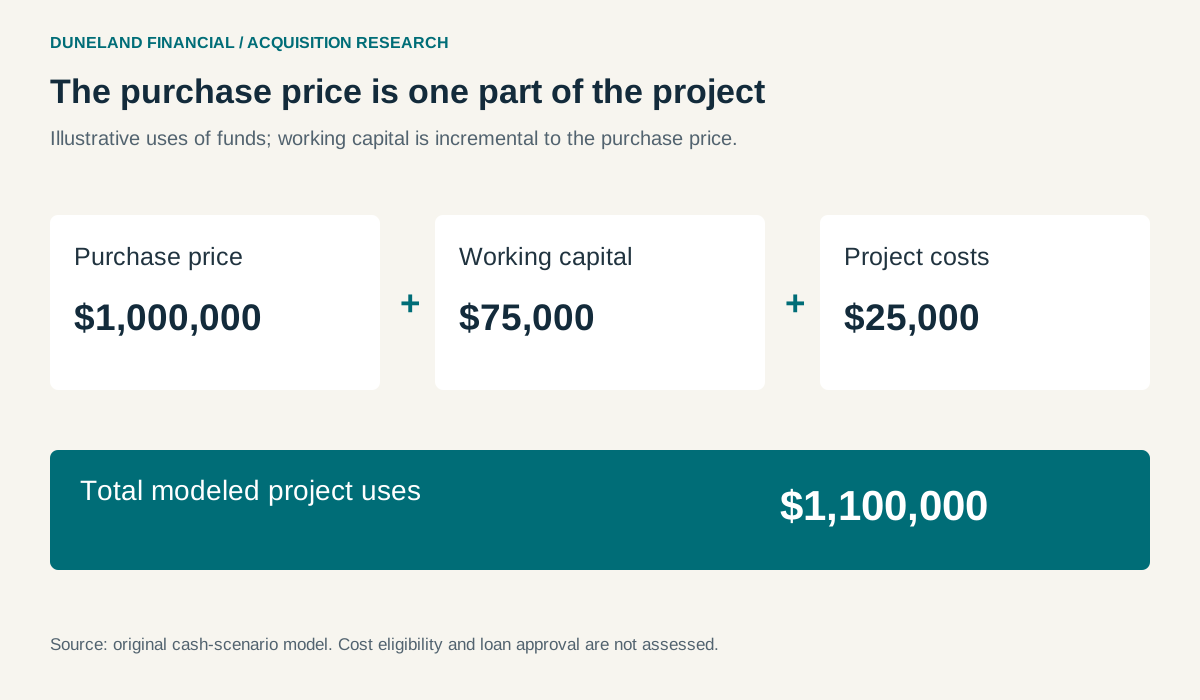
Original model: project uses include incremental working capital and assumed eligible costs.
Frequently asked questions
Is the injection always calculated only on the price paid to the seller?
No. Under 8.1, the applicable calculation includes project uses and category-specific provisions. Owner Buyouts have a distinct purchase-price basis; do not extend one simplified formula to every category. SOP 8.1, Appendix 15
Can I estimate costs before receiving every invoice?
Yes, for planning, if estimates are clearly identified and later reconciled. An estimate should not be presented as a lender-approved eligible cost.
Does a balanced schedule mean the financing works?
No. It proves arithmetic consistency. Eligibility, valuation, contribution treatment, and debt service remain separate tests. SOP 8.1, Appendix 15
Give every dollar a purpose and a place
A good acquisition budget is easy to follow from the agreement to the closing statement. It identifies what the project needs, which sources fund it, what the buyer has already paid, and what remains outside the transaction.
Build that schedule early and update it when the deal changes. This makes a new fee, a revised working-capital requirement, or a change in seller financing visible immediately. It also makes the next financing discussion more productive: the team can evaluate a defined funding gap instead of debating different versions of the purchase price.
Continue to capital-stack design or review your funding plan with Duneland.
Continue reading
- SBA Business Acquisition Financing: A Buyer’s Guide
- How Much Cash Do You Really Need to Buy a Business With an SBA Loan?
- How Business Acquisition Capital Stacks Work
- How Much Cash Does Buying a Business Require? Twenty Modeled Scenarios
- Acquisition financing library