
How Much Cash Do You Really Need to Buy a Business With an SBA Loan?
On this page
Research date: September 17, 2026.
Policy scope: Written September 17, 2026. References to SOP 8.1 describe the incoming framework applicable under SBA’s October 1, 2026 transition notice; prior-version statements are identified separately.
“Five percent down” sounds like a complete answer. For a buyer considering a $1 million business, it can quickly become a $50,000 acquisition budget.
That budget skips several questions. Is the contribution calculated on the purchase price or a larger project? Will the seller accept a note that qualifies? Which expenses are already paid, which remain due, and how much money should stay available after closing?
The useful answer comes from separating those amounts. This guide shows the calculation, the relevant SBA rules, and an example in which a $55,000 project contribution becomes a $120,000 total resource plan.
TL;DR: For an Initial Acquisition governed by SOP 8.1, the required injection is at least 10% of the applicable project cost. Eligible limited sources, including qualifying standby seller debt, can collectively satisfy up to half of that required injection. Buyer cash may therefore be 5% of project cost in a qualifying structure, but separate expenses and retained liquidity can make the buyer’s total resource requirement higher. The lender must still accept the structure and verify repayment capacity. SOP 8.1, Appendix 15
Is the SBA acquisition down payment 5% or 10%?
The required injection and the buyer’s personal cash contribution are different amounts. SOP 8.1 sets a 10% minimum for Initial Acquisitions and limits specified contribution sources to half of that requirement. It does not turn the minimum injection into 5%. SOP 8.1, Appendix 15, “Equity Requirements”
The preceding version also required at least 10% of total project costs for a complete change of ownership, allowing seller debt toward injection only when on full standby for the loan’s life and no greater than half the required injection. Do not present the existence of a qualifying seller-note structure as something first created in October 2026. SOP 8, Standard 7(a), “Equity requirements”
SOP 8.1 applies to applications issued an SBA loan number on or after October 1, 2026. The examples here explain that incoming framework; the lender should confirm which version governs an actual application. Issuance notice
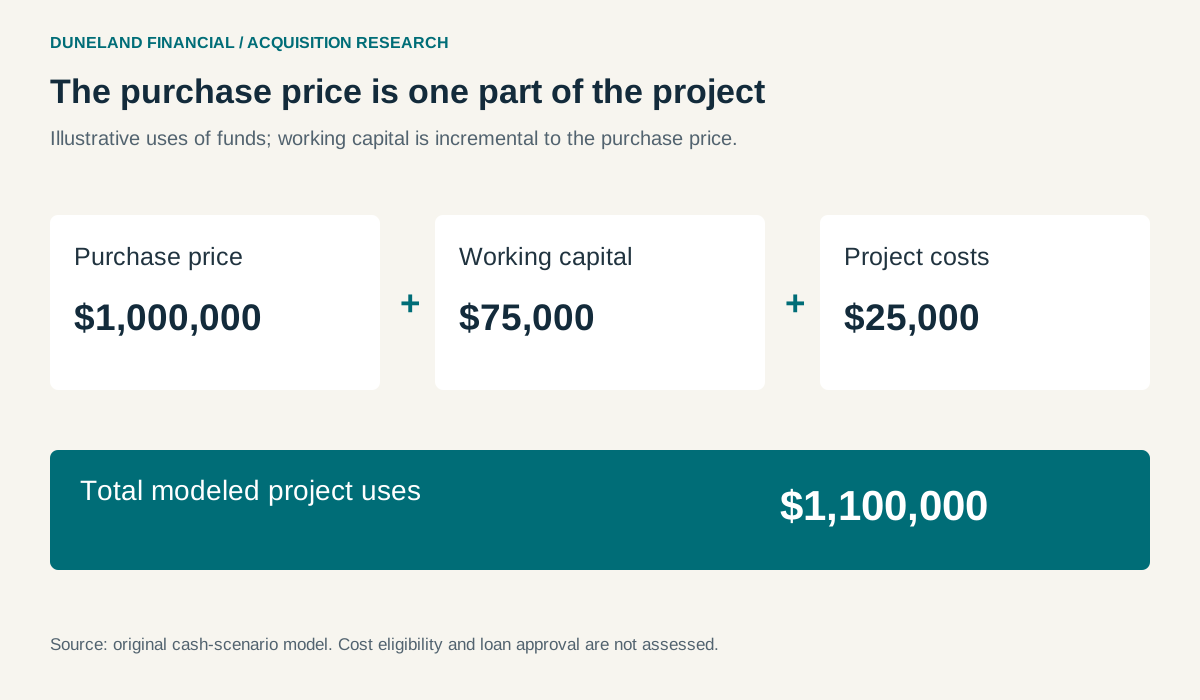
Why is a $1 million purchase sometimes a $1.1 million project?
A financing project can include more than the payment to the seller. Incremental working capital and eligible transaction expenses can increase uses of funds. Under 8.1, the injection calculation accounts for the business project and additional uses included in the request. SOP 8.1, Appendix 15, “Equity Requirements”
Consider this illustration, assuming all listed project uses qualify and working capital is additional to the negotiated purchase package:
| Project use | Amount |
|---|---|
| Business purchase | $1,000,000 |
| Incremental working capital | $75,000 |
| Eligible project expenses | $25,000 |
| Total project | $1,100,000 |
| 10% required contribution | $110,000 |
These are model assumptions, not reported market averages. The difference matters: 10% of this project is $110,000, not $100,000. Scenario methodology
How can a seller note reduce the buyer contribution?
A seller note can change who supplies part of the required injection when the note meets the applicable standby, subordination, documentation, and source-limit requirements. It remains a debt obligation even when receiving permitted injection treatment. SOP 8.1, Appendix 15, “Source of Equity Injections”
For the $1.1 million example:
| Funding source | Buyer-only injection | With qualifying standby seller note |
|---|---|---|
| Senior debt | $990,000 | $990,000 |
| Buyer project contribution | $110,000 | $55,000 |
| Qualifying standby seller note | $0 | $55,000 |
| Total sources | $1,100,000 | $1,100,000 |
The seller note replaces $55,000 of buyer contribution in this model. It does not reduce the senior loan or improve modeled senior-debt coverage. The seller must accept deferred payment on the required terms, and the lender must approve the full arrangement. Scenario methodology; SOP 8.1
Read the seller-note guide before negotiating around that assumption.
Why can $55,000 of contribution require $120,000 of resources?
Cash contributed to the project is only one part of a buyer’s resource plan. Expenses outside the project and money deliberately retained after closing need separate treatment. The following amounts are illustrative planning assumptions, not SBA-mandated reserve levels. Scenario methodology
| Buyer resource component | Amount |
|---|---|
| Buyer contribution to the project | $55,000 |
| Additional unfinanced costs due at closing | $15,000 |
| Cash due at closing | $70,000 |
| Separate diligence expenses already paid | $10,000 |
| Liquidity retained outside the transaction | $40,000 |
| Total resources across the process | $120,000 |
The $10,000 already paid is a separate expense in this illustration; it is not counted again in project costs or the closing wire. Likewise, the retained $40,000 is distinct from the company’s $75,000 working-capital use.
In a real transaction, a paid expense may receive credit toward the required contribution if permitted and documented. That credit must be reflected consistently. Do not add an expense to total cash requirements and then ignore a valid closing credit. See the project-cost guide.
How does the answer change at different prices?
Under one deliberately proportional set of assumptions, the modeled qualifying seller-note structure produces the following results. The assumptions scale with price for comparison; real fees, working capital, and reserves need not scale this way. Twenty-scenario model
| Purchase price | Project uses | Buyer project contribution | Cash due at closing | Total resources, including earlier costs and retained liquidity |
|---|---|---|---|---|
| $500,000 | $550,000 | $27,500 | $35,000 | $60,000 |
| $1,000,000 | $1,100,000 | $55,000 | $70,000 | $120,000 |
| $2,000,000 | $2,200,000 | $110,000 | $140,000 | $240,000 |
| $3,000,000 | $3,300,000 | $165,000 | $210,000 | $360,000 |
These are not minimum-cash quotes. They assume a qualifying seller note, eligible project uses, no valuation gap, and sufficient remaining support for the debt. The full cash study changes the contribution, project costs, seller structure, and retained liquidity.
Can a buyer have enough cash and still fail the debt test?
Yes. Buyer liquidity and business debt capacity test different constraints. Under 8.1, Initial Acquisitions must meet the specified 1.25× historical or adjusted coverage test. Lenders cannot substitute post-closing growth projections for that core requirement. SOP 8.1, Appendix 15, “Lender’s Credit Analysis”
Our $1 million baseline assumes $200,000 of cash flow and a $990,000 loan amortizing monthly over ten years at a fixed illustrative 10%. Annual payments are about $156,995, producing 1.274× coverage. A 10% cash-flow decline reduces that to 1.147×. The buyer’s cash contribution has not changed, but the debt picture has. Scenario methodology
Use the DSCR guide alongside the cash budget. A balanced funding table is not evidence that the business can repay its obligations.
What should you take to a financing review?
Prepare the purchase price, proposed working-capital treatment, target financials, available funds, any investor terms, proposed seller note, and expenses already paid. This is a preparation recommendation, not a complete lender document list. It follows the need to review sources, contribution, valuation, and debt capacity together. SOP 8.1, Appendix 15
Mark each figure as documented, estimated, or negotiated. An uncertain seller note should remain a scenario until the seller and lender accept its terms.
Frequently asked questions
Can I borrow money for my contribution?
Under 8.1, certain personal borrowing can qualify where repayment comes from outside the acquired business’s cash flow; salary from that business does not qualify as the outside repayment source. Other source rules also apply. SOP 8.1, Appendix 15
Is the retained-liquidity amount in this article required by SBA?
No. It is an explicit model assumption. An actual liquidity plan depends on buyer needs, business risks, and lender requirements. Scenario methodology
Can I use this table as a financing approval estimate?
No. It demonstrates how specified assumptions change the budget; it does not assess your eligibility, valuation, or accepted earnings adjustments.
Replace the percentage with a complete cash plan
A down-payment percentage becomes useful only after the project, capital sources, and repayment assumptions are defined. Start with all uses of funds. Identify which sources qualify toward the required contribution. Then distinguish cash consumed before closing, cash due at closing, and liquidity retained afterward.
For the example here, “$55,000 buyer contribution” and “$120,000 total resources” are both correct, but they answer different questions. Knowing which question a number answers helps prevent a financing conversation from becoming a last-minute cash shortfall.
Review your acquisition financing options with a sources-and-uses schedule and the target’s financial information.
Continue reading
- SBA Business Acquisition Financing: A Buyer’s Guide
- Can a Seller Note Reduce Your SBA Acquisition Cash Requirement?
- SBA Total Project Cost: Why Purchase Price Is Only the Starting Point
- DSCR for Acquisition Loans: How Much Debt Can the Business Support?
- Acquisition financing library