
Can a Seller Note Reduce Your SBA Acquisition Cash Requirement?
On this page
Research date: September 17, 2026.
Policy scope: Written September 17, 2026. References to SOP 8.1 describe the incoming framework applicable under SBA’s October 1, 2026 transition notice; prior-version statements are identified separately.
A seller agreeing to “carry 10%” can make an acquisition feel closer to funded. But the amount alone does not tell the buyer whether that note reduces the required cash contribution, replaces senior debt, or adds a payment the business must support.
Those outcomes depend on the note’s terms and the governing program rules. A seller who expects monthly payments immediately after closing is offering something different from a seller willing to defer principal and interest for the full SBA loan term.
TL;DR: Under SOP 8.1, seller debt can receive injection treatment when it is subordinated to the lender and on full standby for the entire 7(a) loan term. Limited contribution sources collectively may cover no more than half of required injection. An ordinary payment-bearing seller note may still form part of a permitted structure, but it does not automatically reduce the buyer’s required contribution. SOP 8.1, Appendix 15
What is a seller note?
A seller note records an obligation to pay part of the acquisition consideration over time. In a sources-and-uses model, it represents financing supplied by the seller. Its principal, rate, payment schedule, security, and maturity determine its cash-flow effects. In an SBA transaction, the lender reviews those terms alongside other financing. SOP 8.1, Appendix 15, general requirements and credit analysis
Consider a $1 million purchase with $100,000 deferred to the seller. The buyer has not eliminated that $100,000 obligation. The transaction has assigned it a different creditor and repayment schedule.
See the general seller-financing guide for broader economics. The remainder of this article addresses SBA-specific contribution treatment.
What does full standby mean?
Under 8.1, full standby means no principal or interest payments for the term of the 7(a) loan. The rules permit interest to accrue under the stated conditions, require a standby agreement with the note attached, and address subordination and creditor enforcement. SOP 8.1, Appendix 15, “Standby Debt Agreements”
Accrual and payment are different. A seller may accumulate an economic claim without receiving cash during the standby period. Both parties need to understand what remains payable later and which documents govern it.
This is a substantial commercial term for the seller. It should not appear for the first time when closing documents arrive.
Is subordination the same as standby?
No. Subordination addresses the seller creditor’s relative rights; standby addresses permitted payments and enforcement restrictions under the required arrangement. The incoming rules require subordinated seller debt on full standby for it to receive the specified injection treatment. SOP 8.1, Appendix 15, “Seller Debt”
A note described as “junior” does not, by that label alone, satisfy full standby. Likewise, an informal statement that the seller will be patient is not equivalent to the required executed documentation.
Ask the lender to review the full proposal: amount, interest, payments, maturity, collateral, subordination, and intended treatment toward injection.
How does qualifying seller debt change the cash contribution?
For a modeled $1.1 million Initial Acquisition project requiring $110,000 of injection, an eligible $55,000 standby seller note can cover half that requirement if the limited-source conditions are met. The remaining buyer contribution is $55,000. SOP 8.1, Appendix 15; Scenario methodology
| Source | Amount |
|---|---|
| Senior loan | $990,000 |
| Buyer contribution | $55,000 |
| Qualifying standby seller note | $55,000 |
| Total | $1,100,000 |
The senior loan remains $990,000. If the seller contribution is replacing buyer cash, it has not reduced the senior debt payment. This distinction is why a low-cash structure can still fail a coverage test.
The cash-required article adds expenses and retained liquidity to this example.
How is ordinary seller financing different?
A seller note outside injection can change the allocation between senior and seller debt without reducing the required buyer contribution. Its scheduled payments also enter the debt-capacity analysis under applicable rules. The appendix specifically addresses additional acquisition debt that is not on full standby, including its treatment when structured interest-only. SOP 8.1, Appendix 15, “Lender’s Credit Analysis”
For a different hypothetical $1.1 million structure:
| Source | Amount |
|---|---|
| Senior loan | $880,000 |
| Buyer contribution | $110,000 |
| Ordinary seller note | $110,000 |
| Total | $1,100,000 |
Here, seller financing replaces part of senior debt. It does not replace the buyer’s $110,000 contribution. Whether the structure is permitted and supportable requires lender review. Scenario methodology
What should be settled before signing an LOI?
The buyer should identify the intended function of seller financing before negotiating around it. Is the note meant to satisfy part of injection, reduce senior borrowing, bridge valuation, or accommodate seller economics? Different functions can require different terms. This preparation recommendation follows the separate contribution and repayment requirements in Appendix 15. SOP 8.1
Prepare a one-page financing summary with both the proposed note and a fallback if the lender does not accept the intended treatment. Ask counsel how financing assumptions should be reflected in the transaction documents. Do not assume a generic “seller financing subject to lender approval” sentence resolves every economic disagreement.
The pre-LOI guide provides a broader readiness sequence.
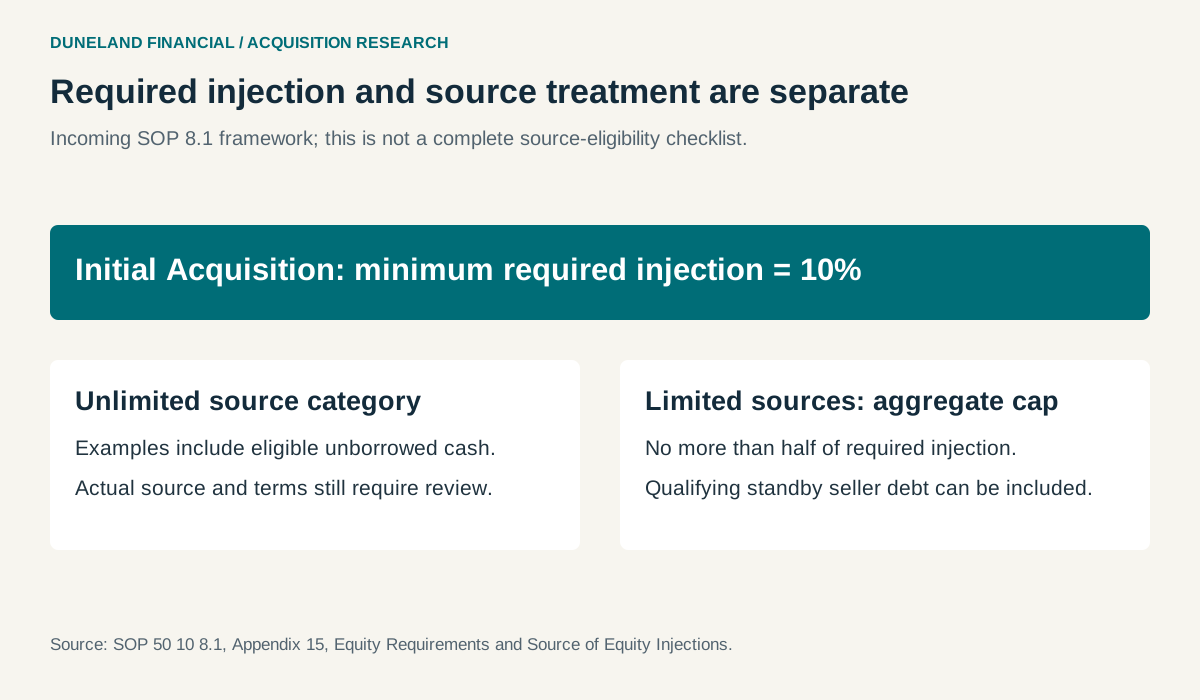
SOP 8.1 Appendix 15 summary. Consult the full source conditions and transaction category.
Frequently asked questions
Can the seller collect interest immediately and still provide the standby injection?
Not under the full-standby definition discussed here: payments of both principal and interest are prohibited during the 7(a) term. Accrual is a separate matter. SOP 8.1, Appendix 15
Can I automatically refinance a standby note after three years?
Do not assume that. The appendix’s seller-note refinancing rules refer to a note being in place and current, not on standby, for the specified period, with additional refinancing conditions. A full-standby contribution should not be sold to the seller as a guaranteed three-year exit. SOP 8.1, Appendix 15, “Debt Refinancing”
Is a seller earnout the same thing as a seller note?
No. An earnout makes consideration depend on performance conditions. The incoming acquisition rules prohibit seller earnouts. A fixed note and a performance-contingent payment should not be treated as interchangeable. SOP 8.1, Appendix 15, general requirements
Agree on the note’s job before agreeing on its amount
Seller financing can help an acquisition, but only when the parties understand what it accomplishes. The same dollar amount can satisfy part of a contribution in one structure and add an ordinary repayment obligation in another.
Discuss intended treatment with the lender while the terms can still change. Give the seller a clear account of payment timing and the required restrictions. Then test the resulting debt schedule and the buyer’s remaining cash needs together. A well-understood seller note is more useful than a large headline amount with incompatible assumptions.
Review your proposed acquisition structure with the purchase price, financials, and complete seller-note terms.
Continue reading
- SBA Business Acquisition Financing: A Buyer’s Guide
- How Much Cash Do You Really Need to Buy a Business With an SBA Loan?
- Seller Financing in a Business Acquisition: Structure and Tradeoffs
- What to Resolve About Acquisition Financing Before Signing an LOI
- Acquisition financing library