
What to Resolve About Acquisition Financing Before Signing an LOI
On this page
Research date: September 17, 2026.
An acquisition LOI can set expectations about price, seller financing, diligence, and timing before the financing structure has been tested. The risk is not that every detail must be final at that stage. It is that an important assumption becomes the basis for negotiation without anyone checking whether it works.
A useful early financing review identifies those assumptions. It distinguishes a plausible route from a committed loan and gives the buyer concrete questions to resolve with the lender, seller, and transaction counsel.
TL;DR: Before relying on an LOI’s financing assumptions, test the buyer’s capital, target earnings, full project uses, seller-note terms, and likely diligence requirements. Establish what remains conditional. An early review can improve the structure, but it should not be represented as final underwriting or legal approval. SBA application guidance; SOP 8.1, Appendix 15
What can be assessed before every document is available?
A preliminary review can examine the proposed transaction, available financial evidence, buyer profile, and capital plan. The strength of any conclusion depends on what has actually been verified. SBA’s application guidance notes that required documents vary by loan and processing method. SBA 7(a) program
Prepare a target summary with price, business activity, ownership structure, real estate, historical earnings, and proposed seller involvement. Mark financial periods clearly. Identify missing tax, interim, valuation, or source-of-funds information instead of implying the file is complete.
The purpose is to find the questions likely to change the deal, not to pretend early information can answer everything.
Which cash assumptions should be tested first?
Build a complete project budget and a separate buyer resource plan. A price-based down payment can omit working capital, expenses, or retained liquidity. Under incoming 8.1, contribution treatment also depends on source rules and transaction category. SOP 8.1, Appendix 15
Ask whether the seller-note assumption is essential to closing. If the buyer needs contribution credit but the seller expects immediate payments, that conflict should surface before price and financing terms are treated as agreed.
Use the cash-required guide and seller-note guide to make those distinctions explicit.
How should price be tested against debt capacity?
Estimate the debt payments required by the proposed structure and compare them with supportable earnings. Under 8.1, the prescribed acquisition coverage test relies on historical or supported adjusted results, not a future growth plan used to fill the gap. SOP 8.1, Appendix 15, “Lender’s Credit Analysis”
A buyer who intends to increase sales after closing can still evaluate that plan. It should not be confused with earnings already demonstrated for the core underwriting requirement.
Ask which add-backs have support, how owner compensation is treated, and whether all acquisition debts are included. The DSCR guide explains the calculation.
Which diligence requirements can change the timetable?
Report scope and commissioning can create dependencies that should be understood before committing to a short schedule. Under 8.1, valuation is required for acquisition analysis, and Initial Acquisitions or Business Expansions at the defined $3 million purchase-price threshold require lender-benefit QoE as well. SOP 8.1, Appendix 15, “Financial Due Diligence”
Do not assume a buyer-commissioned report will satisfy the lender’s requirements. Confirm what is needed, who orders it, and whether the seller can provide the required financial and bank records.
The QoE guide explains the threshold and reliance provisions. The timeline guide places reports within the wider process.
How should financing questions be brought into the LOI discussion?
Give transaction counsel a clear statement of the assumptions that remain open: funding sources, permitted seller terms, report requirements, valuation, and expected lender conditions. Counsel can address the actual LOI provisions and their legal effect. SBA’s acquisition guidance emphasizes transaction agreements and financing review; this article provides preparation questions rather than contract language. SOP 8.1, Appendix 15
Do not assume every LOI is entirely nonbinding or that a generic financing sentence protects every position. The actual document and applicable law matter. The buyer’s useful contribution is a precise account of what the financing plan depends on.
What should be on the pre-LOI checklist?
Use a completeness checklist with evidence and an owner for each unresolved item. It is not a probability-of-approval score. Buyer preparation framework based on SBA acquisition requirements
| Question | Evidence or next action |
|---|---|
| Is the buyer’s capital documented? | Source records and restrictions |
| Is the whole project budgeted? | Sources and uses, including working capital |
| Are earnings supportable? | Financial history and documented adjustments |
| Are seller terms compatible? | Written proposal reviewed by financing team |
| Is the likely category established? | Lender’s program analysis |
| Are required reports identified? | Scope, commissioning, and record needs |
| Is timing based on dependencies? | Owners and prerequisites for remaining work |
| Are financing assumptions clear to counsel? | Written issues list for document review |
If several items remain open, that does not require abandoning the target. It means the negotiation should reflect uncertainty rather than imply the financing is already settled.
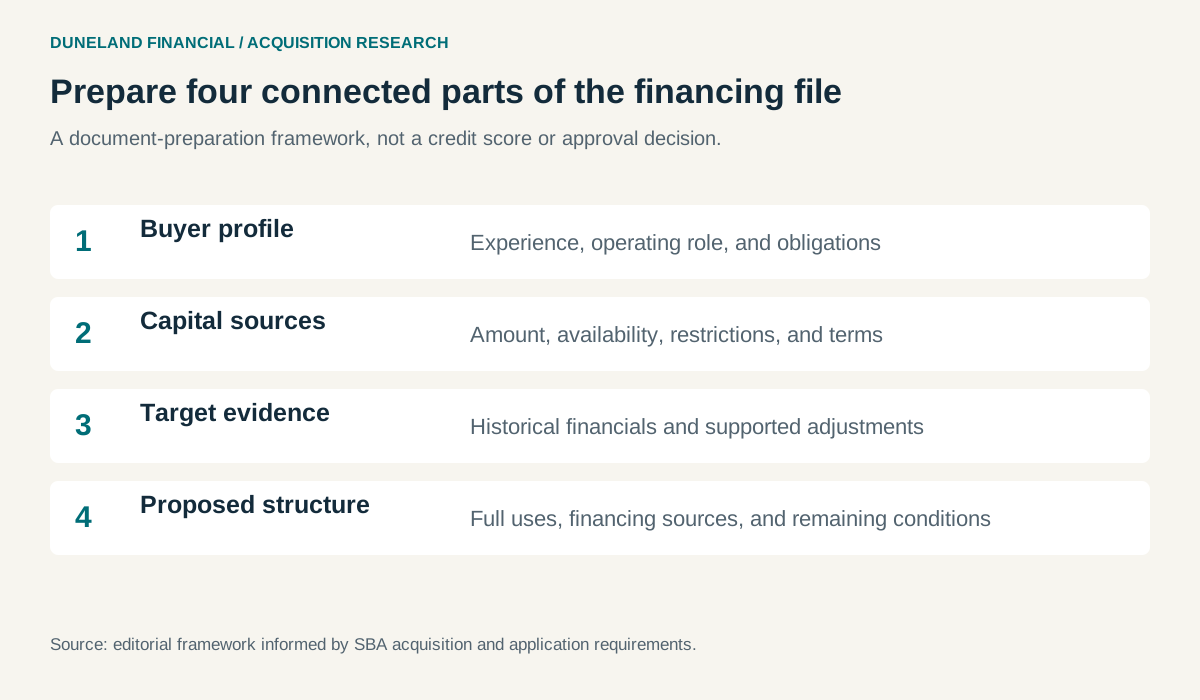
Editorial preparation framework; document completeness is not credit approval.
Frequently asked questions
Do I need to wait for an LOI before speaking with an advisor?
A buyer can prepare and discuss available information earlier. A transaction-specific lender decision still requires the necessary documents and underwriting. SBA application guidance
Does prequalification guarantee funding?
Read the actual communication and conditions. An early review should not be represented as completed underwriting.
What if the business looks attractive but the financing does not work?
Identify the constraint: cash, earnings, price, terms, eligibility, or execution. Evaluate changes before assuming another lender will solve the same issue. OCC commercial lending guidance
Negotiate with the financing assumptions visible
The goal before an LOI is not certainty about every detail. It is clarity about the conditions that could change the acquisition. A documented cash plan, a realistic repayment model, compatible seller terms, and a known diligence path make the negotiation more informed.
Bring unresolved financing issues into the discussion while price, timing, and structure can still be adjusted. That gives the buyer a better chance of pursuing a deal whose economics remain coherent as diligence becomes more detailed.
Review your target before finalizing financing assumptions with Duneland.
Continue reading
- Acquisition Financing Readiness: What Buyers Should Prepare
- How Much Cash Do You Really Need to Buy a Business With an SBA Loan?
- Can a Seller Note Reduce Your SBA Acquisition Cash Requirement?
- DSCR for Acquisition Loans: How Much Debt Can the Business Support?
- Acquisition financing library