
Business Acquisition Financing Timeline: Stages and Common Delays
On this page
Research date: September 17, 2026.
“How long will financing take?” often hides several different questions. How long until a lender reviews the file? How long until reports are complete? When will documents be signed? When will money actually be available?
A useful acquisition timeline separates those milestones and connects them to prerequisites. A single day count can conceal the seller records, underwriting questions, third-party reports, and legal conditions that determine whether the target date is realistic.
TL;DR: Build the financing timeline around dependencies: buyer preparation, target records, lender review, required diligence, credit conditions, legal documentation, and funding. Some tasks can overlap, but a pending prerequisite can delay several later steps. Published SBA processing times describe specific program steps and should not be presented as the total time to buy a business. SBA lender resources; SOP 8.1, Appendix 15 and closing requirements
Where does the financing timeline begin?
Preparation can begin before a target is selected, but a transaction-specific timeline depends on the business, structure, lender, and available records. SBA’s guidance says application contents vary with the loan and processing method. SBA 7(a) program
Organize buyer resources and experience during the search. Once a target is identified, add the price, financial history, proposed uses, and seller terms. The readiness guide provides a document framework.
A timeline should state its starting condition. “From complete financial package” is different from “from first introduction,” and neither means “from signed LOI” unless that is explicitly the starting event.
What happens during initial lender review?
The financing team assesses whether the borrower, target, and proposed structure warrant further review. That can expose missing information or assumptions that need revision before the transaction proceeds. It should not be confused with satisfaction of all underwriting and funding conditions. OCC commercial lending guidance; SBA application guidance
Useful outputs include the likely route, required documents, unresolved contribution treatment, and the next decision. Record what the lender has actually reviewed rather than describing every positive discussion as an approval.
How does diligence affect the schedule?
Required diligence creates both a production task and a potential decision point. The report must be completed, then its findings must fit the proposed financing. Under 8.1, acquisition valuation and applicable QoE requirements are part of underwriting, and accepted findings can change debt capacity or the contribution needed. SOP 8.1, Appendix 15
A report delay may begin with missing seller records rather than the report provider. Prepare the financial statements, tax data, bank statements, and explanations required for the agreed scope.
For transactions near the defined $3 million threshold, resolve QoE requirements early. Do not discover the commissioning restriction after commissioning a different report.
Which tasks can run in parallel?
Tasks can overlap when their prerequisites are sufficiently clear and the parties understand the risk of work needing revision. Buyer documentation, seller record collection, legal preparation, and report scoping may progress at the same time. Final figures and documents still need to agree with the accepted structure. This is a suggested workflow, not an official universal sequence. SOP 8.1, acquisition and closing requirements
| Workstream | Typical preparation dependency | Completion evidence |
|---|---|---|
| Buyer file | Defined ownership and capital plan | Requested records supplied securely |
| Target financial review | Complete period-specific records | Questions and adjustments resolved |
| Sources and uses | Price and project assumptions | Reconciled funding schedule |
| Valuation/QoE | Required scope and provider access | Reports meeting applicable requirements |
| Credit conditions | Accepted analysis and structure | Documented conditions resolved |
| Legal/closing | Transaction and lender requirements | Executed documents and satisfied conditions |
| Funding | Required verification and disbursement steps | Confirmed release of funds |
Why is approval not the same as funding?
A credit decision can leave conditions that must be satisfied before disbursement. The incoming SOP’s closing requirements include verification of required injection, collateral, and other applicable conditions. A buyer should therefore track both the decision and the remaining path to funding. SOP 8.1, Section B, Chapter 6
Ask which conditions are outstanding, who owns each one, and what evidence closes it. A generic “we are approved” update is less useful than a specific account of reports, documents, and funding requirements still open.
What commonly changes the planned date?
Any unresolved prerequisite can affect the schedule. In an acquisition, examples include incomplete financial records, disputed adjustments, a revised purchase price, incompatible seller-note terms, or a diligence finding that changes debt capacity. These are process dependencies drawn from the required reviews, not measured claims about their frequency. SOP 8.1, Appendix 15
The buyer can improve visibility by maintaining one issues list. For each item, record the current question, responsible party, required evidence, and consequence for the structure or timetable. Avoid promising a final date while a critical item has no owner.
How does the October 2026 transition affect planning?
SBA’s notice ties 8.1 applicability to applications issued an SBA loan number on or after October 1, 2026. A planned closing date is not enough to establish the governing version. Issuance notice
For a transaction spanning the transition, confirm the loan-number status and lender interpretation, then update diligence, coverage, and contribution assumptions if needed. The policy guide explains the incoming framework.
Do not compress a complex financing process into an unsupported deadline promise simply to target one rulebook.
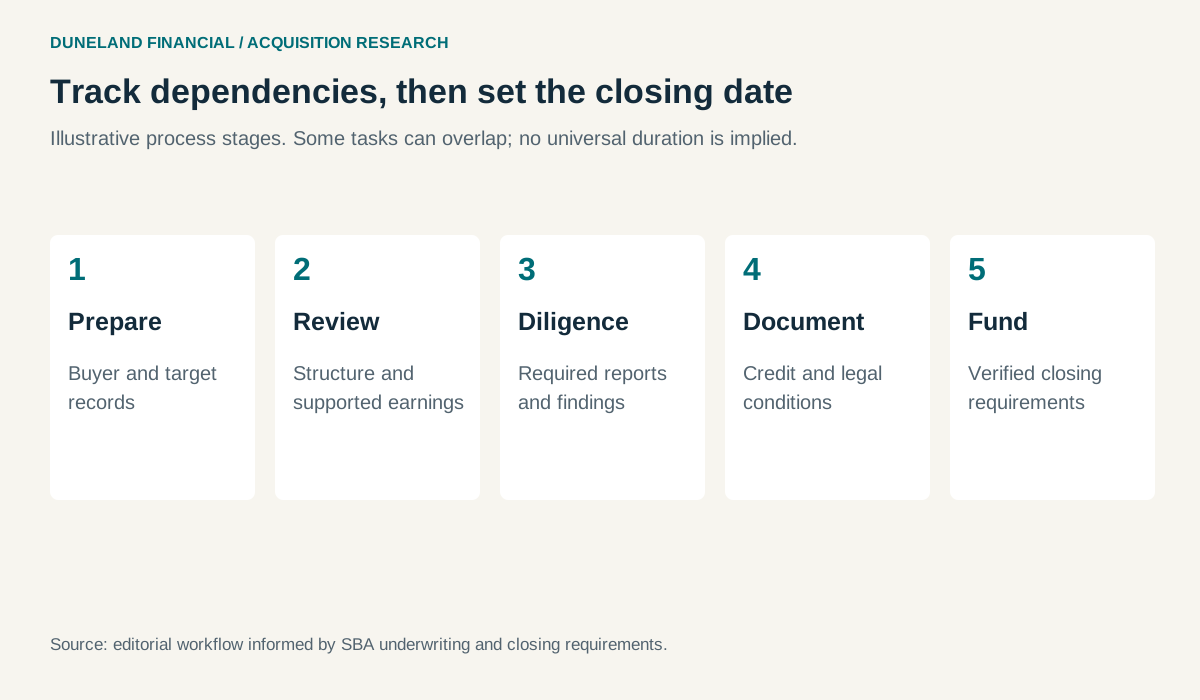
Illustrative sequence; some tasks overlap and no universal completion time is promised.
Frequently asked questions
Is an SBA processing estimate the total acquisition timeline?
No. It describes a particular processing step and excludes other transaction work. SBA lender resources
Can I speed up the process by ordering every report immediately?
Confirm required scope and commissioning first. A report that does not satisfy the actual requirement may not advance the lender’s process. SOP 8.1, Appendix 15
What is the most useful weekly update?
A short list of completed decisions, unresolved critical items, owners, and changed assumptions. This is a coordination recommendation rather than a program requirement.
Manage the prerequisites behind the closing date
A credible financing timeline explains what has to happen for the next milestone to occur. It separates preparation, credit review, diligence, documentation, and funding rather than presenting them as one undifferentiated waiting period.
Build that sequence with the financing team and update it when the structure changes. Give each unresolved item an owner and a required piece of evidence. That makes delays easier to diagnose and prevents a target date from becoming a substitute for an executable plan.
Review your acquisition financing sequence with Duneland, starting with the pre-LOI preparation guide.
Continue reading
- Acquisition Financing Readiness: What Buyers Should Prepare
- SBA SOP 50 10 8.1: What Acquisition Buyers Need to Know Before October 1
- SBA Acquisition Quality of Earnings: The $3 Million Threshold and Buyer Preparation
- What to Resolve About Acquisition Financing Before Signing an LOI
- Acquisition financing library