
SBA SOP 50 10 8.1: What Acquisition Buyers Need to Know Before October 1
On this page
Research date: September 17, 2026.
Policy scope: Written September 17, 2026. References to SOP 8.1 describe the incoming framework applicable under SBA’s October 1, 2026 transition notice; prior-version statements are identified separately.
A business buyer approaching an SBA financing deadline needs to know which event determines the rulebook. The date an LOI was signed and the date a closing is planned are not substitutes for the application event identified in SBA’s transition notice.
SOP 50 10 8.1 introduces a dedicated acquisition appendix with category-specific contribution, diligence, and coverage requirements. The buyer’s task is to translate those provisions into an actual structure: who is buying, what is being acquired, which capital sources qualify, and which earnings support repayment.
TL;DR: SBA’s issuance notice makes SOP 8.1 applicable to applications issued an SBA loan number on or after October 1, 2026. Appendix 15 governs changes of ownership, excludes 7(a) Small processing for those transactions, and distinguishes Initial Acquisition, Business Expansion, Owner Buyout, and ESOP & Cooperative categories. Buyers should confirm applicability, category, contribution sources, diligence scope, and historical coverage before relying on the proposed financing. Issuance notice; SOP 8.1, Appendix 15
Which date determines whether SOP 8.1 applies?
The issuance notice says 8.1 applies to applications issued an SBA loan number on or after October 1, 2026. It also instructs lenders to continue using 8.0 for applications submitted through September 30. For a file spanning the boundary, verify the actual loan-number status and the lender’s application of the notice; do not assume an earlier submission or planned closing settles the issue. SBA Information Notice 5000-880695, page 1
As of this article’s September 17, 2026 research date, October 1 is still in the future. The provisions below describe the incoming 8.1 framework. An existing application may be governed by the preceding framework and intervening notices.
Why does the acquisition category matter?
Appendix 15 treats Initial Acquisition as the default category. To use Business Expansion, Owner Buyout, or ESOP & Cooperative treatment, the lender must document qualification. The classification changes more than the name of the transaction; it affects the tests used to underwrite it. SOP 8.1, Appendix 15, “Types of Changes of Ownership”
| Category | Selected incoming distinction |
|---|---|
| Initial Acquisition | 10% minimum injection cannot be reduced; 1.25× coverage test |
| Business Expansion | Qualification includes operating-history and same four-digit industry-group conditions; 1.15× coverage test |
| Owner Buyout | Specific ownership/guarantee conditions; 1.25× coverage test |
| ESOP & Cooperative | Specialized conditions; 1.25× coverage test; qualifying ESOP controlling-interest purchases have an injection exception |
This table is a routing summary, not the complete qualification test. Business Expansion status is not established simply because the buyer already owns another company. SOP 8.1, Appendix 15
Is a 10% acquisition injection a new rule?
No. SOP 8 already imposed at least a 10% total-project-cost injection for complete changes of ownership and allowed qualifying full-standby seller debt up to half that required injection. The incoming appendix reorganizes the framework and expressly distinguishes limited and unlimited contribution sources. SOP 8, Standard 7(a), “Equity requirements”; SOP 8.1, Appendix 15
That distinction matters for accurate headlines. Buyers should not be told that all seller-financing flexibility disappears or that a 10% rule first begins in October. Instead, review which sources qualify in the actual structure, including investor terms and the aggregate limited-source cap.
The equity-injection guide explains source treatment, while the cash guide explains the broader resource budget.
What changes in debt-service coverage?
Under 8.1, the category-specific coverage test must be met using the last fiscal year or an average of the last two fiscal years on a historical or supported adjusted basis. The lender must consider post-closing projections but may not rely on them to meet this core requirement. Initial Acquisitions require 1.25×; qualifying Business Expansions require 1.15×. SOP 8.1, Appendix 15, “Lender’s Credit Analysis”
The preceding Standard 7(a) credit discussion used a 1.15× historical and/or projected cash-flow requirement. That comparison should remain scoped to those provisions rather than presented as proof that every old SBA acquisition used identical underwriting. SOP 8, Standard 7(a), cash-flow analysis
A buyer whose financing depended on aggressive future growth should revisit the structure with documented historical earnings and supported adjustments. The DSCR article provides a worked example.
When does the $3 million QoE requirement apply?
For Initial Acquisitions and Business Expansions under 8.1, Business Purchase Price of at least $3 million triggers a lender-benefit Quality of Earnings report in addition to valuation. The threshold is calculated before applying buyer equity, seller debt, or other financing. Owner-occupied commercial real estate is excluded from the defined Business Purchase Price. SOP 8.1, Appendix 15, “Financial Due Diligence”
A smaller senior loan does not automatically avoid the threshold. For example, a $3.2 million business purchase financed with $2.5 million of senior debt remains above $3 million on the relevant price measure, assuming no excluded owner-occupied real estate component.
See the QoE guide for commissioning, cash proof, and reliance requirements.
What happens to small acquisition loans and loan terms?
The incoming appendix does not permit 7(a) Small loans for changes of ownership. It also sets a ten-year maximum amortization for the acquisition component and addresses transactions that include owner-occupied real estate through separate loans or a weighted blended structure. A 7(a) acquisition loan may not have a balloon. SOP 8.1, Appendix 15, introduction and “Loan Maturities”
This is a reason to revisit assumptions, not a reason to conclude that smaller acquisitions cannot be financed. The lender needs to identify the permitted processing and structure.
What should buyers do before the transition?
Prepare a short lender discussion covering applicability, category, sources, earnings, reports, and amortization. That checklist follows the independent requirements in the notice and Appendix 15. Issuance notice; SOP 8.1
Ask for the current loan-number status, the chosen acquisition category and basis, the accepted contribution sources, the earnings period used for coverage, the required valuation/QoE scope, and any change to terms. Update the cash budget and transaction timetable together if one assumption changes.
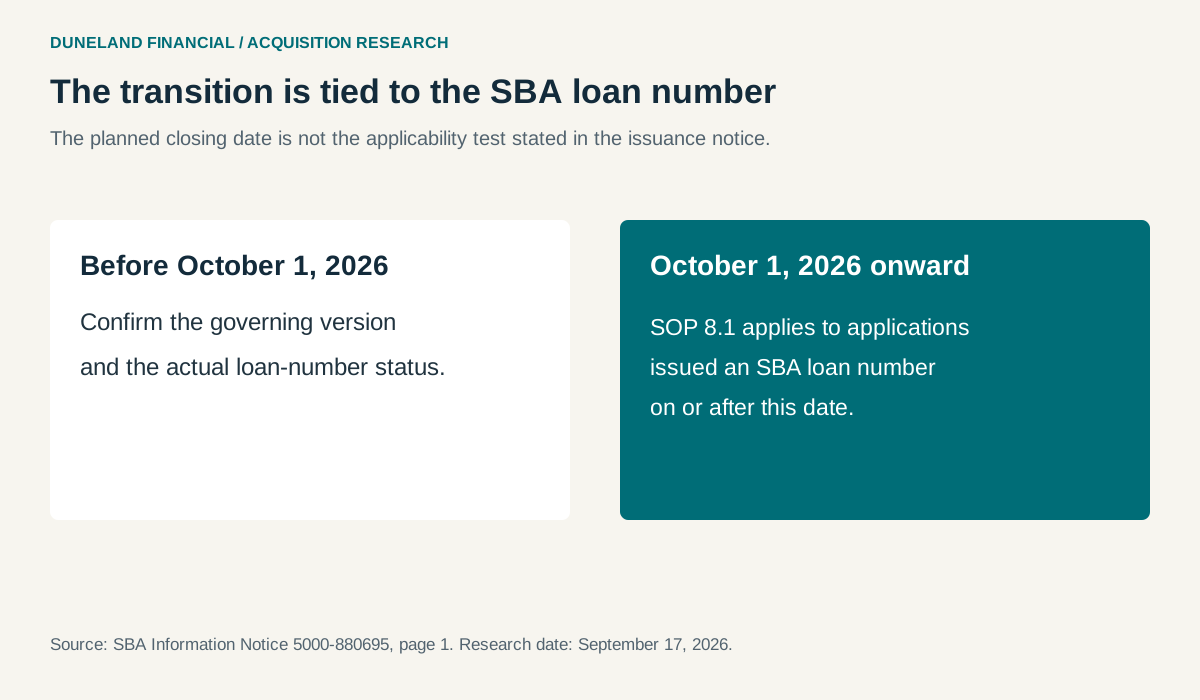
Source: SBA Information Notice 5000-880695, page 1; research date September 17, 2026.
Frequently asked questions
Does signing an LOI before October 1 preserve the old rules?
The notice’s applicability language is tied to issuance of an SBA loan number. An LOI date is not the stated test. Issuance notice
Can projections rescue insufficient historical coverage under 8.1?
The appendix requires the prescribed historical or adjusted test and says projections may not satisfy that requirement. SOP 8.1, Appendix 15
Does every $3 million loan require the acquisition QoE report?
The relevant trigger is the defined Business Purchase Price for specified categories, not any loan amount with a $3 million label. SOP 8.1, Appendix 15
Translate the transition into a financing decision
The most useful response to a new SOP is a reviewed transaction model. Establish applicability first, classify the acquisition, then recalculate contribution, debt capacity, and diligence needs under that framework.
Avoid negotiating solely around a deadline. If the structure depends on a seller receiving immediate payments, a report commissioned by the buyer, or projected growth filling a coverage gap, those assumptions deserve explicit review. Resolving them early gives the buyer and seller a clearer basis for price, timing, and funding discussions.
Review your acquisition structure with Duneland, or begin with the SBA financing overview.
Continue reading
- SBA Business Acquisition Financing: A Buyer’s Guide
- How Much Cash Do You Really Need to Buy a Business With an SBA Loan?
- SBA Equity Injection: Sources, Documentation, and Buyer Cash
- DSCR for Acquisition Loans: How Much Debt Can the Business Support?
- Acquisition financing library