
SBA Equity Injection: Sources, Documentation, and Buyer Cash
On this page
Research date: September 17, 2026.
Policy scope: Written September 17, 2026. References to SOP 8.1 describe the incoming framework applicable under SBA’s October 1, 2026 transition notice; prior-version statements are identified separately.
A buyer can have money available and still lack a documented contribution that fits the financing rules. The source may be borrowed. An investor may expect early distributions. A seller note may require immediate payments. Each detail can change how the lender treats the money.
Equity-injection review therefore has two parts: establish the required contribution and establish which sources qualify toward it. Keeping those questions separate helps buyers avoid negotiating a structure that appears funded but depends on an ineligible source.
TL;DR: For Initial Acquisitions under SOP 8.1, at least 10% of the applicable project cost must satisfy the injection requirement. The SOP distinguishes unlimited sources from limited sources, with the latter collectively capped at half of required injection. A source’s name is not enough: repayment, control, distribution rights, documentation, and actual movement of funds matter. SOP 8.1, Appendix 15, “Equity Requirements” and “Source of Equity Injections”
What does equity injection mean in an acquisition?
For financing analysis, required equity injection is the contribution that must be supplied from sources accepted under the program’s rules. It does not automatically equal ownership equity, personal cash, or money retained after closing. A qualifying standby debt instrument can receive injection treatment while remaining debt. SOP 8.1, Appendix 15
That distinction matters when comparing proposals. A $50,000 seller note and $50,000 of unborrowed buyer cash are not economically identical, even if both contribute to an accepted injection structure.
The cash-required guide separates contribution from the buyer’s total resources. This article focuses on source treatment and the evidence needed to support it.
What is the minimum injection for an Initial Acquisition?
SOP 8.1 requires a 10% minimum for Initial Acquisitions and does not permit that requirement to be reduced or eliminated. The same appendix contains different treatment for other acquisition categories, including qualifying reductions for Business Expansions and Owner Buyouts and the specified ESOP exception. SOP 8.1, Appendix 15, “Equity Requirements”
A $1.1 million modeled project therefore starts with a $110,000 requirement at 10%. A buyer should not use $100,000 simply because the seller’s asking price is $1 million. Additional uses and category-specific calculation rules must be considered.
These are the incoming 8.1 rules. The issuance notice ties applicability to an SBA loan number issued on or after October 1, 2026. SBA issuance notice
Which sources are unlimited or limited under 8.1?
“Unlimited” describes the source-category limit, not an assurance that the lender accepts any amount or ignores its origin. “Limited” sources are collectively capped at half of required injection, subject to the appendix’s specific treatment of additional funds needed to address a valuation-supported funding gap. SOP 8.1, Appendix 15
| Source category | Core condition in the incoming rules |
|---|---|
| Unborrowed cash | Source and contribution must be established |
| Certain personal borrowing by a guarantor | Repayment demonstrated from outside business cash flow; salary from the acquired business does not qualify |
| Grants without conditional repayment | No relevant repayment, clawback, or similar condition during the loan term |
| Standby debt | Full-term standby, required documentation, and other stated conditions |
| Seller debt counted as contribution | Subordination and full-term standby |
| Non-controlling minority equity investment | Less than 20% ownership, no control, and required restrictions on repayment/distributions |
The first three are listed as unlimited sources; the final three are limited sources. Read the complete provisions with the lender before treating a specific instrument as eligible. SOP 8.1, Appendix 15, “Source of Equity Injections”
Why do investor distribution rights matter?
Money described as equity can carry terms that conflict with program treatment. Under 8.1, non-controlling minority equity used as eligible injection cannot require repayment or recovery distributions before release of the SBA guarantee. Equity investments used to meet injection are also subject to restrictions on non-tax distributions until the 7(a) loan is paid off. SOP 8.1, Appendix 15
A buyer should therefore supply the actual investor agreement, not merely report the amount committed. A preferred return, redemption right, or control provision may affect the lender’s analysis. Legal and financing review should happen before the arrangement is treated as a settled funding source.
What evidence should a buyer prepare?
Injection is not established by showing a balance once. The lender must verify the required contribution before disbursing loan proceeds and retain evidence that the funds were supplied and used as intended. SOP 8.1, Section B, Chapter 6, closing documentation
A useful preparation file connects source, transfer, and use:
| Stage | Buyer preparation |
|---|---|
| Source | Account records and terms of any borrowing, investment, or grant |
| Transfer | Evidence showing how money reached the appropriate account or closing |
| Use | Closing records or verified paid expenses showing application to the project |
| Terms | Signed note, standby, subordination, or investor documents as applicable |
This is a preparation framework. Follow the lender’s exact checklist and secure submission process; do not send sensitive records through an ordinary blog comment or public form field.
How do paid expenses and deposits affect the calculation?
A buyer should distinguish a separate expense from an amount credited against the contribution. Under the incoming acquisition appendix, applicant-paid financial-diligence report costs can count toward injection. The lender must still verify the expense and its treatment. SOP 8.1, Appendix 15, “Financial Due Diligence”
For example, if a verified $10,000 payment is credited toward a $110,000 buyer contribution, the remaining contribution may be $100,000. Adding the $10,000 again as an extra project use without reconciling the credit would distort the budget. Conversely, an expense that does not receive credit still consumes cash.
Track every payment in the sources-and-uses schedule with its payer, date, purpose, and expected credit.
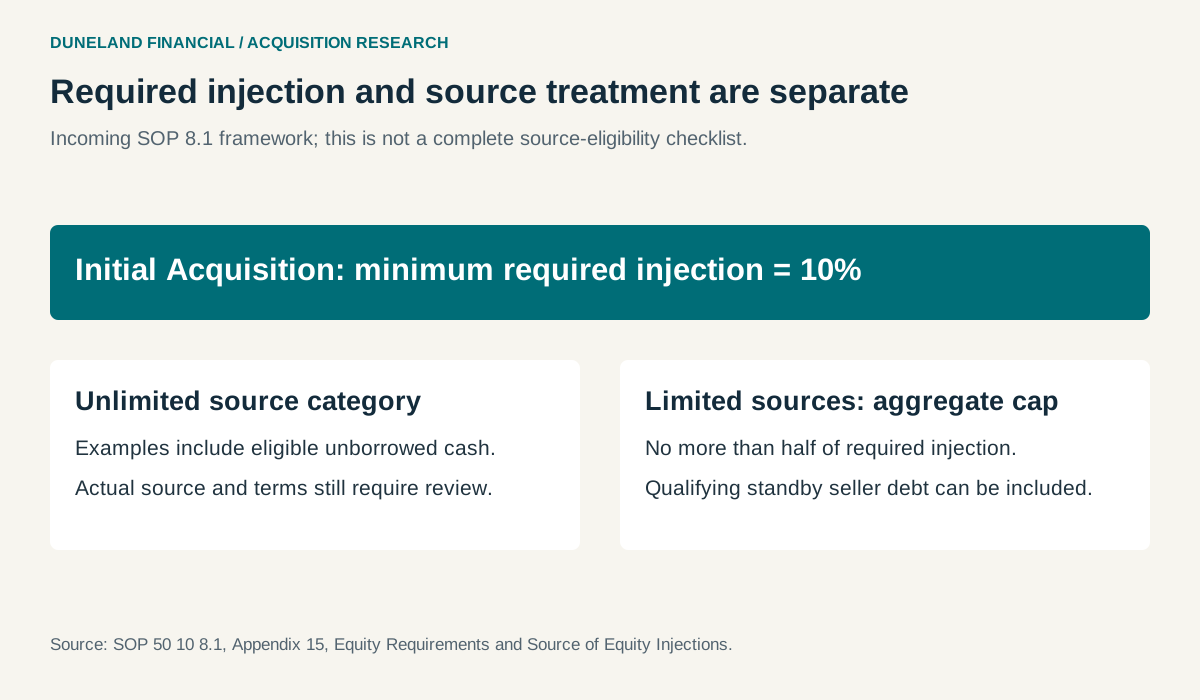
SOP 8.1 Appendix 15 summary. Consult the full source conditions and transaction category.
Frequently asked questions
Does supplying 10% mean I own 10% of the business?
No. Required injection and ownership allocation answer different questions. Ownership follows the transaction and entity documents; the lender reviews those documents as part of the financing. SOP 8.1, Appendix 15
Can the same seller note count twice?
No. In a balanced funding model, the note is one source. If it receives qualifying injection treatment, that is a classification of the same amount, not a second amount of cash. Scenario methodology
Does “unlimited source” mean unlimited borrowing is acceptable?
No. The stated personal-borrowing conditions and the lender’s overall credit review still apply. SOP 8.1, Appendix 15
Document the structure before relying on it
The most useful contribution plan includes a number, a source, and the terms attached to that source. Buyers can then see whether a funding gap reflects insufficient capital, ineligible terms, or incomplete documentation.
Prepare the source trail before negotiating around a minimum contribution. Confirm investor rights and seller-note treatment while changes are still practical. Then reconcile the accepted contribution with the cash actually due at closing. That sequence turns an apparent funding commitment into a structure the lender can evaluate.
Continue with SBA seller notes or prepare for a financing review.
Continue reading
- SBA Business Acquisition Financing: A Buyer’s Guide
- How Much Cash Do You Really Need to Buy a Business With an SBA Loan?
- Can a Seller Note Reduce Your SBA Acquisition Cash Requirement?
- SBA Total Project Cost: Why Purchase Price Is Only the Starting Point
- Acquisition financing library