
DSCR for Acquisition Loans: How Much Debt Can the Business Support?
On this page
Research date: September 17, 2026.
Policy scope: Written September 17, 2026. References to SOP 8.1 describe the incoming framework applicable under SBA’s October 1, 2026 transition notice; prior-version statements are identified separately.
A buyer can have enough money for the contribution and still be asking the business to service too much debt. The cash-to-close problem and the repayment problem are related, but they are not interchangeable.
Debt service coverage ratio, or DSCR, is a way to compare defined earnings or cash flow with included debt payments. The calculation is simple. The important work is deciding which earnings are supportable and which obligations must be included.
TL;DR: DSCR equals defined cash flow available for debt service divided by included debt service. Under incoming SOP 8.1, Initial Acquisitions require 1.25× coverage using the specified historical or adjusted test; Business Expansions use 1.15×. More buyer cash helps only if it changes the debt structure or another relevant constraint. A seller note that replaces buyer contribution without reducing senior debt does not improve the senior payment calculation. SOP 8.1, Appendix 15; Scenario methodology
What does a coverage ratio mean?
In a simple model, 1.00× coverage means $1 of defined cash flow for each $1 of included debt service. A higher ratio leaves a larger mathematical cushion. It does not by itself account for every operating risk or establish approval. The lender’s definition of the numerator and denominator determines what the ratio measures. OCC commercial lending guidance
| Defined annual cash flow | Included annual payments | DSCR |
|---|---|---|
| $200,000 | $200,000 | 1.00× |
| $230,000 | $200,000 | 1.15× |
| $250,000 | $200,000 | 1.25× |
These are arithmetic illustrations. A threshold becomes a program requirement only within its applicable rule and transaction category.
What is the incoming SBA acquisition requirement?
SOP 8.1 requires 1.25× for Initial Acquisitions, Owner Buyouts, and ESOP & Cooperative transactions, and 1.15× for Business Expansions. The ratio must be met using the last fiscal year or an average of the last two fiscal years on a historical or supported adjusted basis. SOP 8.1, Appendix 15, “Lender’s Credit Analysis”
The appendix defines historical coverage as EBITDA divided by combined post-transaction debt service. It provides for justified adjustments, specifies global coverage considerations, and does not allow post-closing projections to meet the core test. These rules apply under the 8.1 framework effective October 1, 2026. SOP 8.1; Issuance notice
Do not import an EBITDA figure from a listing and assume the lender will accept it unchanged.
Which earnings adjustments deserve scrutiny?
An adjustment needs an explanation of why it is prudent, supportable, and consistent with ongoing operations. The incoming appendix identifies items such as non-recurring income, capital expenditures, distributions, discretionary expenses, and owner compensation for analysis; it does not declare every proposed add-back acceptable. SOP 8.1, Appendix 15
Consider a seller who adds back all compensation because the buyer will manage the business. The buyer still needs to meet personal obligations. Under 8.1, compensation adjustments require supporting global cash-flow analysis, and the proposed compensation must support current obligations and living expenses.
A practical review separates reported earnings, proposed adjustments, documentary support, and the lender-accepted result. The difference between the first and last number can change the financeable price.
How can a rate change affect the same acquisition?
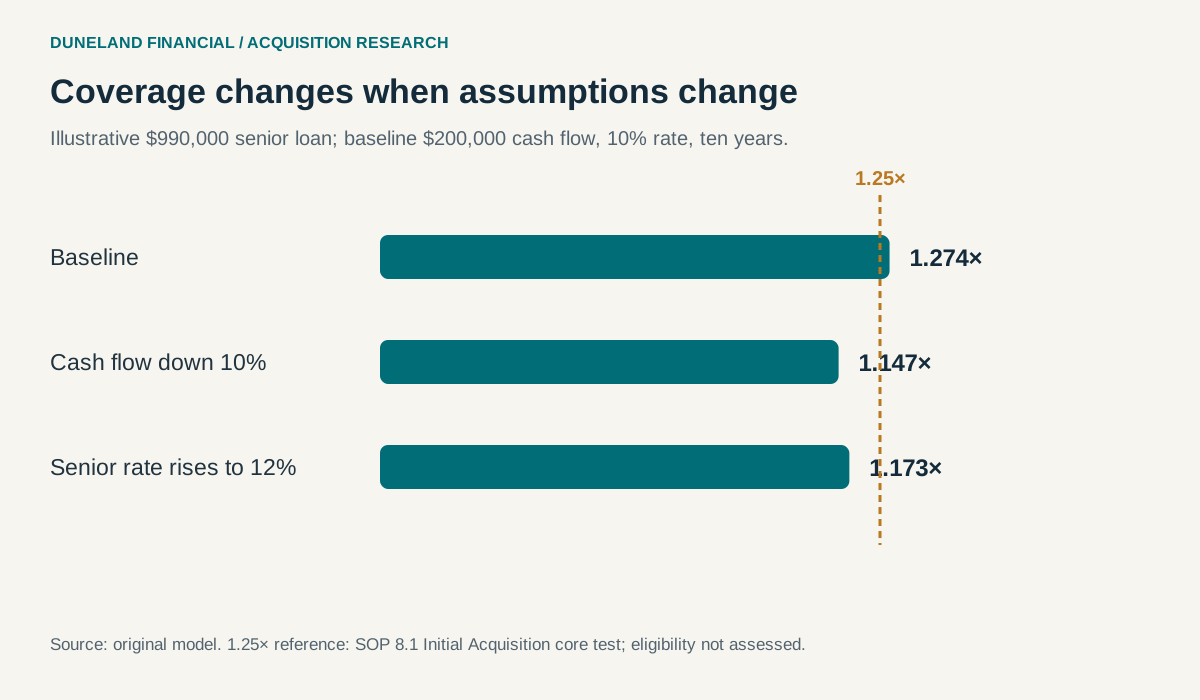
Our illustrative $990,000 loan is fully amortizing over ten years with monthly payments. At an assumed fixed 10%, annual debt service is approximately $156,995. With $200,000 of modeled cash flow, coverage is 1.274×. At 12%, annual payments rise to about $170,443 and coverage falls to 1.173×. Scenario methodology
| Scenario | Annual modeled cash flow | Annual senior payments | DSCR |
|---|---|---|---|
| 10% rate | $200,000 | $156,995 | 1.274× |
| 12% rate | $200,000 | $170,443 | 1.173× |
| 10% rate, earnings down 10% | $180,000 | $156,995 | 1.147× |
These rates are sensitivity assumptions, not current quotes. A floating-rate loan requires analysis of its actual reset mechanics and terms.
Does seller financing improve coverage?
It depends on what the seller financing replaces and whether payments are required. In the model, a $55,000 full-standby seller note replaces $55,000 of buyer contribution while the $990,000 senior loan stays unchanged. Current modeled debt service therefore stays unchanged. Scenario methodology
A different seller note could replace senior principal but require its own payments. Those payments cannot simply disappear from underwriting. Under 8.1, additional acquisition debt that is not on full standby and is structured interest-only must be assessed using amortization no longer than ten years, subject to the stated line-of-credit exception. SOP 8.1, Appendix 15
Read the seller-note guide before assuming that deferred purchase consideration solves a repayment problem.
How do you estimate debt capacity from coverage?
Within a simplified model, maximum included annual debt service equals accepted cash flow divided by the required coverage ratio. If cash flow is $200,000 and the test is 1.25×, annual debt service capacity is $160,000 before considering other requirements. Calculation methodology
The next step is to subtract other included annual obligations and convert the remaining senior-payment capacity into principal using the actual rate and amortization. The answer is a debt-capacity estimate, not an automatic purchase-price ceiling or commitment.
A valuation limitation, required equity, collateral rule, or other lender condition can still constrain the deal. See how much business you can afford.
Frequently asked questions
Is DSCR the same as an interest coverage ratio?
No. Debt service commonly includes principal and interest, while an interest-only coverage measure has a different denominator. Always read the metric definition. OCC commercial lending guidance; Federal Reserve private-credit analysis
Can more equity fix low coverage?
If it reduces required debt payments, it can improve the modeled ratio. It cannot automatically correct unsupported earnings or every other underwriting issue. Scenario methodology
Should I use a calculator?
A calculator helps reproduce arithmetic when its inputs and definitions match the question. Start with Duneland’s DSCR calculator, then confirm the lender’s actual test. Its output is not approval.
Test the repayment plan before the purchase price hardens
A DSCR result is most useful when the supporting assumptions are visible. Define cash flow, document adjustments, include the relevant debts, and test plausible downside cases. Then ask whether the remaining cushion fits the business’s operating risks.
If the structure is tight, identify the cause before negotiating a solution. A lower price, more accepted equity, a different debt schedule, or a revised financing route affects the model differently. Simply finding cash for the contribution does not answer the repayment question.
Review your target’s financing capacity with historical financials and the proposed debt schedule.
Continue reading
- SBA Business Acquisition Financing: A Buyer’s Guide
- Can a Seller Note Reduce Your SBA Acquisition Cash Requirement?
- How Much Business Can I Afford to Buy?
- Acquisition financing library