
How Much Business Can I Afford to Buy?
On this page
Research date: September 17, 2026.
Dividing your available cash by a down-payment percentage produces a number quickly. It does not establish an acquisition budget.
A useful budget must satisfy both the buyer’s resource constraint and the business’s repayment constraint. It must also account for project uses beyond price and money the buyer plans to retain. If any of those assumptions changes, the apparent buying power changes with it.
TL;DR: Estimate affordability from two directions: how much project funding your usable cash supports and how much debt the target’s accepted cash flow supports. Reconcile both with working capital, costs, other financing, valuation, and retained liquidity. The result is a scenario to review, not a lender commitment or a universal purchase-price multiple. Scenario methodology; SOP 8.1, Appendix 15
How much of your cash is actually available for the project?
Start with documented funds, then distinguish previous transaction spending, separate closing expenses, and retained liquidity. What remains can be modeled as a project contribution, subject to the source’s eligibility and the lender’s acceptance. Scenario methodology
In a simplified illustration, a buyer begins with $200,000 of total resources, has spent $10,000 on separate diligence, expects $15,000 of additional non-project costs, and plans to retain $40,000. That leaves $135,000 for the modeled project contribution.
Those amounts are assumptions. A cost receiving an accepted contribution credit would need different treatment. The project-cost guide shows how to avoid double-counting.
What project size might that contribution support?
If the full contribution must come from the buyer and the assumed required contribution is 10%, $135,000 corresponds to $1.35 million of project uses. If incremental project uses are assumed to equal 10% of price, the implied purchase price is approximately $1.227 million: $1.35 million divided by 1.10. Calculation methodology
That is a cash-constrained illustration, not a statement that the buyer can obtain the remaining debt. It depends on the stated assumptions and ignores other possible limits until they are tested.
Under incoming SBA 8.1, qualifying limited contribution sources may change the buyer-cash portion of injection, but the aggregate cap and source conditions apply. A seller note cannot be assumed before its terms are accepted. SOP 8.1, Appendix 15
How much debt can the target support?
A simplified debt-capacity calculation divides accepted annual cash flow by the required coverage ratio to find the maximum included annual debt service. The actual lender test determines which earnings, adjustments, and obligations are included. SOP 8.1, Appendix 15, “Lender’s Credit Analysis”
For $200,000 of accepted cash flow at a 1.25× test, included annual debt service cannot exceed $160,000 in the simplified model. Subtract any other included debt payments before converting the remaining payment capacity into senior principal using the proposed rate and amortization.
If the resulting debt amount plus accepted contribution cannot fund the project, the cash-based price estimate is too high under those assumptions. A business’s earnings therefore impose a constraint that a personal cash multiple cannot capture.
Which constraint determines the practical budget?
The practical model must satisfy every relevant constraint at once. Cash capacity, debt capacity, valuation, program eligibility, and lender requirements are separate checks; the weakest unresolved one can prevent the structure from working. SOP 8.1, Appendix 15
| Test | If it fails, investigate |
|---|---|
| Buyer resources | Contribution, costs, retained liquidity, or source terms |
| Debt service | Price, accepted earnings, debt amount, or payment schedule |
| Valuation support | Price and additional equity treatment |
| Program/transaction fit | Structure or another financing route |
| Execution | Documents, diligence, and conditions still outstanding |
This is a planning framework, not an underwriting score. It helps name the problem so the buyer can evaluate a relevant response.
What does the twenty-scenario study show?
In our $1 million purchase examples, modeled total buyer resources range from $120,000 to $230,000 across five configurations. Those figures include project contribution, separate expenses, and retained liquidity. They are not observed market minima or averages. Twenty-scenario model
The lower-cash configuration uses a qualifying standby seller note. The higher-contribution configuration uses 15% buyer contribution. A higher-project-cost configuration needs $181,500 of total resources but produces only 1.203× coverage under its earnings and debt assumptions, below the incoming Initial Acquisition 1.25× test.
That example shows why the question is not resolved by having enough money to close. Read the full cash study for the assumptions and complete outputs.
How should you stress-test the budget?
Change one assumption at a time before testing combined downside scenarios. Lower accepted earnings, increase the modeled rate, increase working capital, remove an uncommitted seller note, or raise separate expenses. Track which change first creates a funding or repayment gap. Scenario methodology
The baseline $1 million model has 1.274× coverage at $200,000 cash flow and the stated 10% rate. Reducing cash flow by 10% produces 1.147×. The original buyer contribution is still available, but the modeled repayment cushion no longer meets the same test.
Stress tests are not predictions. They expose dependency on assumptions so the buyer can decide what evidence and protection are needed.
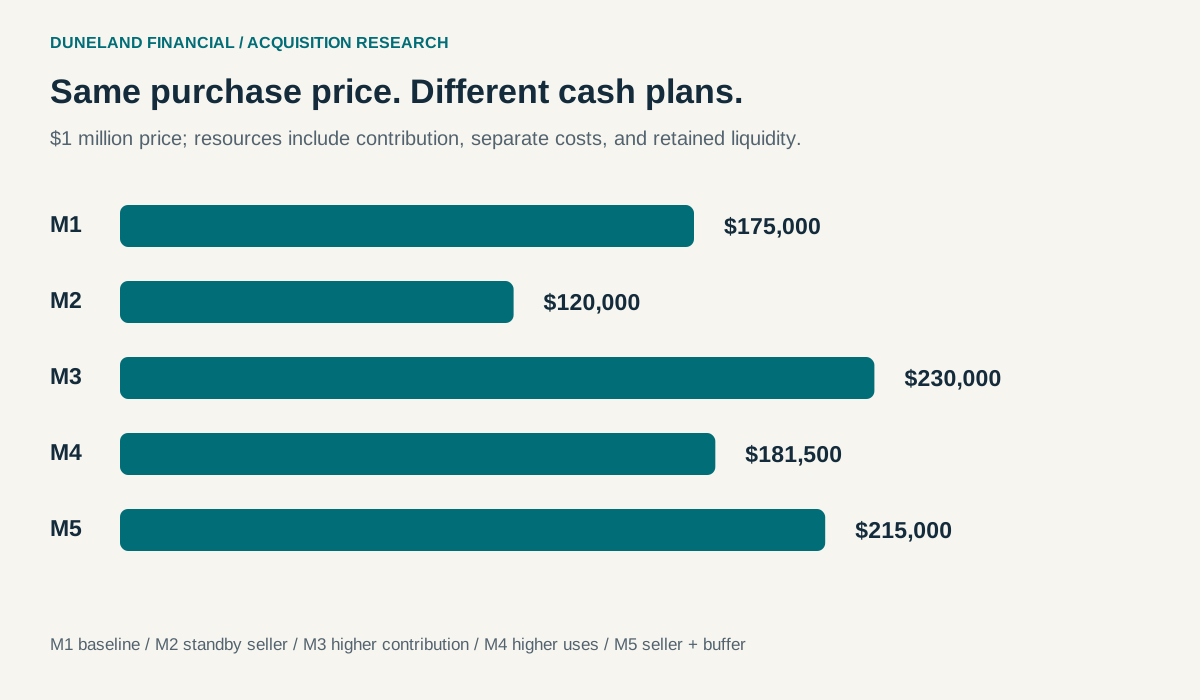
Original model; includes contribution, separate expenses, and retained liquidity.
Frequently asked questions
Can more buyer cash increase the affordable price?
Potentially, but only if the other constraints remain satisfied. More cash does not make unsupported earnings reliable or remove program restrictions. SOP 8.1
Can seller financing double my buying power?
There is no universal multiplier. Its effect depends on whether it replaces contribution or senior debt and on required payments. Scenario methodology
Can I use a listing’s SDE directly as lender cash flow?
Do not assume that. The lender’s accepted earnings definition and adjustments need to be established. SOP 8.1, Appendix 15
Set a budget you can explain
A defensible acquisition budget shows how available resources, project uses, and supported debt fit together. It makes room for transaction spending and retained liquidity without using the same dollar twice. It also identifies the earnings and financing assumptions that must hold.
Use the model to screen and prepare, then replace estimates with evidence as the target becomes more concrete. If the numbers stop working, identify the binding constraint before increasing the bid or adding another financing source.
Review your acquisition budget with Duneland and bring both your resource summary and the target’s historical financials.
Continue reading
- Acquisition Financing Readiness: What Buyers Should Prepare
- SBA Total Project Cost: Why Purchase Price Is Only the Starting Point
- How Much Cash Does Buying a Business Require? Twenty Modeled Scenarios
- Acquisition financing library