
SBA Acquisition Quality of Earnings: The $3 Million Threshold and Buyer Preparation
On this page
Research date: September 17, 2026.
Policy scope: Written September 17, 2026. References to SOP 8.1 describe the incoming framework applicable under SBA’s October 1, 2026 transition notice; prior-version statements are identified separately.
A buyer may pay for financial diligence and still need a different report for the lender. The issue is not just whether someone reviewed the financial statements. The report’s purpose, independence, scope, and intended beneficiary matter.
SBA’s incoming acquisition framework makes those distinctions particularly important for larger transactions. A Quality of Earnings report can affect the accepted earnings used in underwriting, which can in turn change the amount of supportable acquisition debt.
TL;DR: Under SOP 8.1, Initial Acquisitions and Business Expansions with a defined Business Purchase Price of at least $3 million require a lender-benefit QoE report in addition to business valuation. The threshold excludes owner-occupied commercial real estate and is assessed before subtracting buyer equity or seller financing. The required report includes cash proof and must feed the lender’s coverage analysis. SOP 8.1, Appendix 15, “Financial Due Diligence”
What does Quality of Earnings examine?
The incoming SOP describes QoE as financial diligence examining the reliability, sustainability, and accuracy of earnings. Its required work includes reconciliation of financial information, documented adjustments, and review of matters such as customer concentration, contract continuity, and the sustainability of margins. SOP 8.1, Appendix 15, “Quality of Earnings”
For a buyer, the practical question is how much of the reported performance is likely to remain available under the acquisition structure. An unusually profitable year, a related-party arrangement, or an aggressive add-back can deserve more analysis than a listing summary provides.
QoE does not create future earnings. It provides evidence for evaluating what the financial history supports.
Most of the add-backs a QoE examines arrive inside a seller’s discretionary earnings figure. What SDE includes, and which add-backs survive verification covers that side of the same question.
How is QoE different from business valuation?
Valuation and QoE answer connected but different questions. The business valuation supports the value of the acquired business. QoE examines the earnings evidence used in financial diligence. Under 8.1, qualifying transactions at or above the threshold require both; the QoE does not replace valuation. SOP 8.1, Appendix 15
| Report | Main question | Financing consequence |
|---|---|---|
| Business valuation | What value does the analysis support? | A price above supported value can require additional equity |
| Quality of Earnings | What earnings are supported by the required analysis? | Accepted earnings feed the debt-service-coverage calculation |
A buyer can therefore face two separate constraints: a valuation gap and insufficient cash flow for the proposed debt.
What exactly is measured against $3 million?
For Initial Acquisitions and Business Expansions, the trigger is Business Purchase Price as defined in Appendix 15, not the senior loan amount. Owner-occupied commercial real estate is excluded using its appraised value. Buyer equity and seller financing do not reduce the price measure used for the threshold. SOP 8.1, Appendix 15, general requirements and “Quality of Earnings”
Two illustrations show the distinction:
- A $3.2 million business purchase with no real estate remains above the threshold even if the senior loan is only $2.5 million.
- A combined $4 million purchase with $1.2 million of appraised owner-occupied commercial real estate leaves a $2.8 million Business Purchase Price for this test, assuming the appraisal and allocation meet the rules.
These are threshold illustrations, not complete eligibility assessments. The lender can still have its own diligence needs. Owner Buyout and ESOP & Cooperative transactions are excluded from this particular program QoE requirement. SOP 8.1
Can the lender use the buyer’s existing report?
Do not assume so. The required QoE must be performed by an independent, experienced financial professional for the lender’s benefit, and the appendix says it may not be prepared by or for the borrower or seller. The business valuation also has lender-request and reliance requirements. SOP 8.1, Appendix 15, “Financial Due Diligence”
A buyer’s own diligence can still serve the buyer’s decision. That does not make it a substitute for the program-required report. Resolve commissioning and scope early so that the transaction team understands which reports are needed and who can rely on them.
What is cash proof and why does it matter?
The required QoE includes a cash proof reconciling bank-statement activity with income-statement and tax-return information. Under 8.1, that work covers the trailing twelve months and the last two fiscal years. SOP 8.1, Appendix 15, “Quality of Earnings”
That requirement makes records readiness important. A clean earnings presentation without the supporting bank and tax information may not be enough to complete the prescribed work.
Prepare consistent period labels, complete bank statements, tax filings, internal financials, and explanations for transfers or unusual items. The report provider determines the detailed request; the buyer should not invent adjustments merely to make sources reconcile.
How can the report change financing?
The lender must use the QoE earnings in the coverage determination. If coverage does not support the valuation and proposed debt structure, the loan amount must be reduced accordingly; additional eligible funding may be needed to close the gap. SOP 8.1, Appendix 15, general requirements
For illustration, $300,000 of accepted cash flow supports $240,000 of annual included debt service at 1.25×. If diligence reduces accepted cash flow to $250,000, that capacity falls to $200,000. These are arithmetic consequences of the stated assumptions, not actual report findings.
The DSCR guide explains how annual payment capacity translates into borrowing capacity.
How should buyers budget time and cost?
Obtain the lender’s required scope and a proposal from the qualified provider rather than rely on a universal online price or duration. The incoming rules allow the report’s out-of-pocket costs to be passed to the borrower and allow applicant-paid diligence-report costs to count toward injection. SOP 8.1, Appendix 15
The practical timetable depends on record completeness, scope, review questions, and the need to revise the financing model after findings. Build those dependencies into the acquisition timeline, particularly before committing to a short exclusivity period.
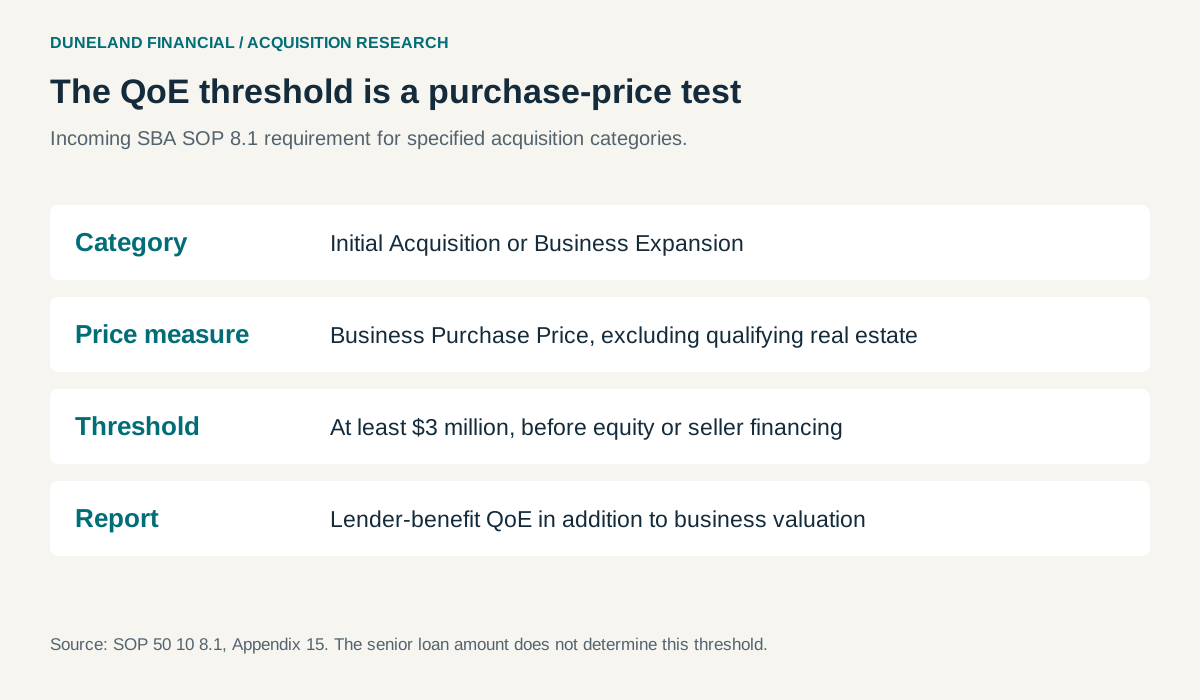
SOP 8.1 Appendix 15: specified categories, at least $3 million before financing sources.
Frequently asked questions
Does a larger buyer contribution avoid the threshold?
No. The threshold is measured before applying buyer equity and other financing sources. SOP 8.1, Appendix 15
Does exactly $3 million trigger it?
For the specified categories and defined Business Purchase Price, the rule uses “equal to or greater than” $3 million. SOP 8.1
Does the report guarantee that the lender accepts the deal?
No. It is part of diligence and underwriting. Findings may change the proposed loan or reveal issues requiring resolution. SOP 8.1
Resolve the report requirements before the timetable depends on them
The $3 million threshold is useful only when the buyer knows what price is being measured and which category applies. Confirm those points, then establish who commissions the reports, what records are required, and how findings will affect the financing model.
That preparation gives diligence a clear role in the acquisition decision. It helps the buyer distinguish a price supported by valuation from debt supported by earnings—and gives the transaction team time to respond if those measures do not align.
Discuss your acquisition financing and diligence sequence before relying on a closing timetable.
Continue reading
- SBA Business Acquisition Financing: A Buyer’s Guide
- DSCR for Acquisition Loans: How Much Debt Can the Business Support?
- Business Acquisition Financing Timeline: Stages and Common Delays
- Acquisition financing library