
What SBA's 2026 Loan Data Reveals About Reported Changes of Ownership
On this page
Research date: September 17, 2026.
A public SBA loan file can help an acquisition buyer understand lending activity. It can also support a misleading conclusion if loan approvals are described as completed business purchases or if a broad program total is relabeled as acquisition financing.
We examined the official 7(a) loan extract covering FY2020 onward, recorded as of June 30, 2026. The file includes a useful category: “Change of Ownership” within the BusinessAge field. That permits a carefully defined analysis of records carrying that label. It does not establish a census of every acquisition financed by the program. Official data file; Official data dictionary
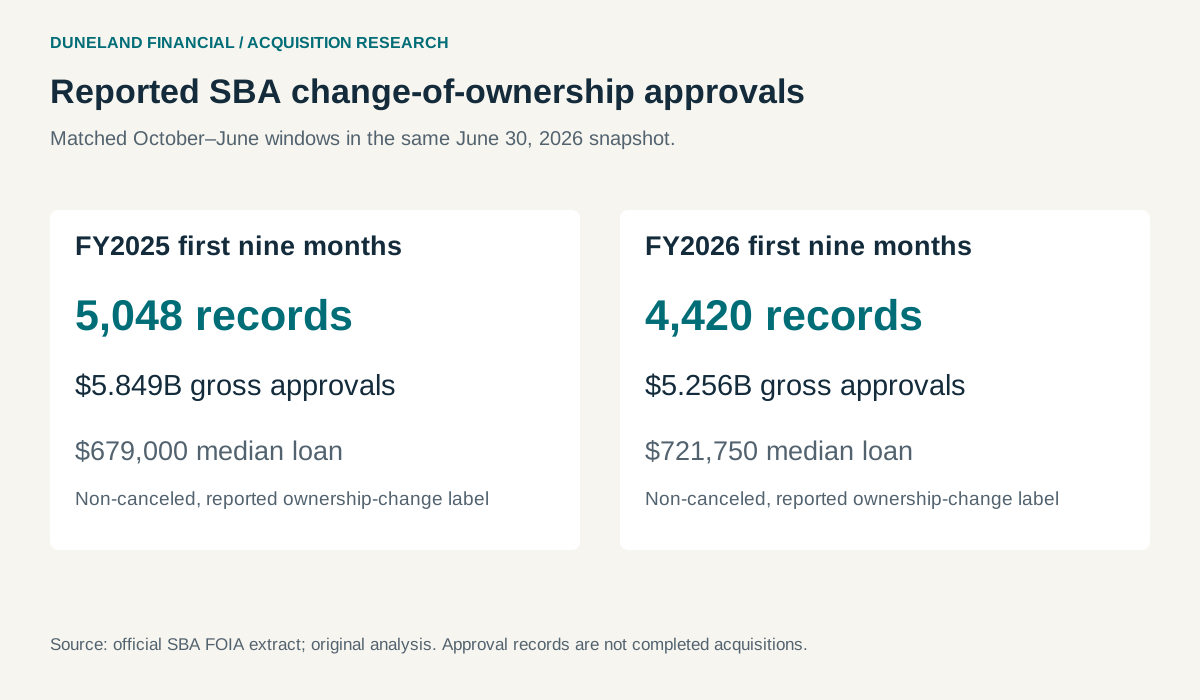
TL;DR: In the June 30, 2026 snapshot, 4,420 non-canceled records approved during October 2025–June 2026 carried the BusinessAge label “Change of Ownership,” representing $5.256 billion of gross approvals. The comparable prior-year window contained 5,048 records and $5.849 billion. These are labeled approval records, not verified completed acquisitions. A third of the current-window records were still marked undisbursed, making the distinction material. Reproducible analysis
What exactly did we analyze?
The source file contains 388,338 rows and 42 fields, all with an AsOfDate of June 30, 2026. We selected records with approval dates in two matched nine-month windows, excluded those marked CANCLD, and retained those whose BusinessAge exactly equals Change of Ownership. Official source; Analysis methodology
The comparison windows are:
- FY2025 comparison: October 1, 2024–June 30, 2025.
- FY2026 comparison: October 1, 2025–June 30, 2026.
Both are evaluated using status in the same June 30, 2026 snapshot. That means the older group has had more time to disburse, repay, cancel, or otherwise change status. Equal approval-window lengths do not eliminate that maturity difference.
The dictionary describes BusinessAge as a categorical field. We observed the exact ownership-change label in the downloaded records; we did not infer acquisitions from business age, loan amount, or borrower names. Data dictionary; Analysis methodology
How many labeled approval records appear in each period?
The filtered FY2026 window contains 4,420 records, compared with 5,048 in the matched FY2025 window. The difference is 628 records, or 12.4%. This is a comparison of the defined, non-canceled labeled subsets as observed at the snapshot date. Analysis results
| Metric | Oct. 2024–June 2025 approvals | Oct. 2025–June 2026 approvals |
|---|---|---|
| Non-canceled records labeled Change of Ownership | 5,048 | 4,420 |
| Gross approval amount | $5,848,742,900 | $5,255,855,600 |
| Median gross approval | $679,000 | $721,750 |
| Records marked COMMIT / undisbursed | 259 | 1,473 |
| Undisbursed share of selected records | 5.1% | 33.3% |
Gross approval amount is down 10.1% between these selected windows, while the median is up 6.3%. The median describes the middle recorded loan approval amount in each subset; it is not a median business purchase price. Analysis results; Data dictionary
Why should approvals not be described as completed acquisitions?
The dictionary defines COMMIT as undisbursed. In the FY2026 selected group, 1,473 of 4,420 records have that status. Counting those records as completed purchases would treat an undisbursed loan record as evidence of a finished acquisition. Data dictionary; Analysis results
The other current-window statuses are 2,946 EXEMPT and one P I F. The dictionary describes EXEMPT as disbursed loans whose current status is withheld under FOIA Exemption 4 when they are not canceled, paid in full, or charged off. That status is not a certificate that the business is performing well. Data dictionary
A first disbursement also does not independently verify every aspect of an acquisition closing. This study therefore uses “approval records” throughout and does not call its totals completed transactions.
Does the median tell buyers what a business costs?
No. GrossApproval is the loan amount defined in the dictionary. Business purchase price, total project uses, seller financing, buyer contribution, and retained liquidity are different measures and are not established by that field. Data dictionary
A loan can fund a project with several sources and uses. A buyer should not take the $721,750 median and infer a standard down payment or an affordable asking price.
For those decisions, build a sources-and-uses schedule and examine the target’s debt capacity. The cash-scenario study illustrates how resources can vary even when purchase price stays the same.
Does this show the entire acquisition market slowed?
The observed subset is smaller in the later window, but the analysis does not establish the cause or measure the full acquisition market. The dataset contains one program, the filter uses one reported classification, and the two cohorts have different time to develop before the common snapshot. Analysis methodology
We cannot infer lender rejection rates because the file is not a dataset of all applications and their approval/denial outcomes. We cannot infer changes in conventional or private-credit acquisitions from these 7(a) records. We also do not know whether the classification captures every relevant ownership transaction consistently across time.
The evidence supports a narrower conclusion: these specifically labeled, non-canceled approval records show lower count and gross amount in the selected later window, with a higher median amount.
Can this data rank the best acquisition lenders?
Not reliably for an individual buyer. The dictionary defines BankName as the bank to which the loan is currently assigned. That is not necessarily proof of the original lender relationship for every record, and activity alone does not measure approval probability, service quality, or fit for a new transaction. Data dictionary
A useful lender review still needs the buyer profile, industry, earnings, project uses, and proposed structure. A public activity count can identify a research lead; it should not become an unsupported “best lender” recommendation.
We have therefore not published an acquisition-lender league table from this extract.
How were duplicates and exclusions handled?
The file contains 391 excess exact duplicate rows across the full extract. It does not expose a dedicated unique loan identifier among its 42 columns. We retained source rows rather than delete potentially distinct records that happen to match; in the two selected Change of Ownership subsets, no exact duplicate rows were present. Analysis methodology
Canceled records were excluded based on the common snapshot’s LoanStatus. Other statuses were retained. Approval dates were used for the period filter, and GrossApproval was summed without substituting the guaranteed portion of the loan.
The released package includes the aggregate results, exact filters, file hash, and a reproducible analysis script. It does not republish borrower names or addresses. Methodology and outputs
What should a buyer take from the findings?
The data provides context about reported lending activity, not a personal financing forecast. Its strongest practical lesson is the importance of defining the measure before using a number in a decision. Approval amount is not purchase price. An undisbursed record is not a completed deal. A current lender field is not proof of a lender’s suitability for the next buyer. Data dictionary
Use the research to ask better questions, then return to the actual transaction. What is the whole project cost? Which capital sources are documented? What earnings support the debt? Which diligence and closing conditions remain open?
Frequently asked questions
Is this a full-year 2026 study?
No. The current window ends June 30, 2026, and covers the first nine months of federal FY2026. It should not be compared with a full fiscal year.
Are the figures approval rates?
No. They are counts and amounts of selected approval records. The denominator of all applications is not available in this analysis.
Does “Change of Ownership” mean every SBA-financed acquisition is included?
We do not claim that. The study includes records carrying that exact reported label and discloses the classification limitation.
Use public data for context and transaction evidence for decisions
The official extract supports a transparent finding: the selected FY2026 window has 4,420 non-canceled records labeled Change of Ownership, with $5.256 billion in gross approvals and a $721,750 median. It also shows why those figures need careful language, especially when one-third of the records remain marked undisbursed.
For a buyer, the next decision should rely on the target’s financial evidence and a complete financing model. Public activity data can inform research, but it does not replace underwriting, establish a down payment, or predict approval.
Continue with the SBA financing guide, or review your acquisition financing options.
Continue reading
- SBA Business Acquisition Financing: A Buyer’s Guide
- SBA Total Project Cost: Why Purchase Price Is Only the Starting Point
- DSCR for Acquisition Loans: How Much Debt Can the Business Support?
- Acquisition financing library